Mixing Brands and Models of Shifters, Rear Derailers and Cassettes

|


Indexed rear-shifting systems from Shimano, SRAM, Campagnolo and SunTour have different amounts of
(Almost any cassette which fits a Shimano cassette body, though, will have a Shimano spacing).
It's often useful to mix and match components to keep an old wheel in service, if you like a particular kind of shifter, etc. etc.
Some nonstandard combinations work with components right out of the box. To achieve a working combination, you also could change the derailer, shifter -- or sprocket spacing:
Other options are to use cable-travel adapter pulley -- or re-route the cable at the rear derailer to increase or decrease its motion. These adaptations are described next, followed by links to tables listing combinations that work.

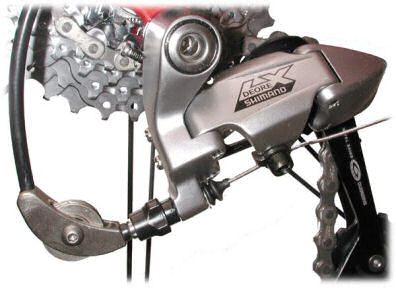
Jtek Shiftmate adapter installed on Shimano derailer
Cable-travel adapters use a double, side-by-side pulley with grooves at two different diameters. The cable enters at one diameter, and exits at the other. An adapter can be installed either to increase or to decrease cable travel.
JTek Engineering's Shiftmate cable-travel adapters are of several different kinds. Demand is low. Order these direct.
Correct ratio does not guarantee success.An adapter may run out of cable travel. JTek does not recommend use of Shiftmate adapters with some derailers, including Shimano XTR derailers. Ask, before you buy.
Most of the JTek Shiftmate adapters are available either angled, for use at the rear derailer, or straight, for use in mid-cable or at a cable stop.
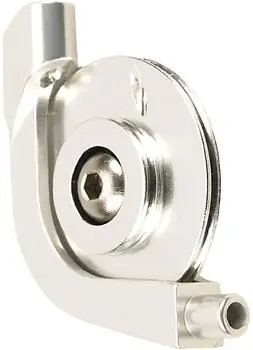 The Problem Solvers Travel Agent is a cable-travel adapter intended mostly to make direct-pull brakes work with ordinary brake levers. It is not intended to solve derailer cable-travel issues.
It is, however, very useful to reduce the amount of friction where cables in housing go around corners. For this, use only the Travel Agent's larger pulley diameter. Cable housing fits into one end or the Travel Agent. The other end must fit into a cable stop.
The Problem Solvers Travel Agent is a cable-travel adapter intended mostly to make direct-pull brakes work with ordinary brake levers. It is not intended to solve derailer cable-travel issues.
It is, however, very useful to reduce the amount of friction where cables in housing go around corners. For this, use only the Travel Agent's larger pulley diameter. Cable housing fits into one end or the Travel Agent. The other end must fit into a cable stop.
Most pulleys used on bicycle cables, including those in shifters, are small enough that the cable will eventually develop metal fatigue (like a paper clip being bent back and forth), fray, and part. This problem is generally tolerated in shifter cables -- but carry a spare cable. A pulley-type adapter adds one more place where this can happen.
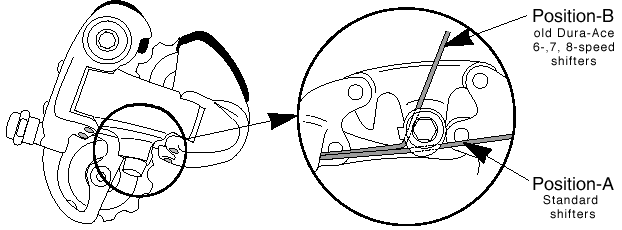
Alternate cable routings for Shimano derailers adapt them for use with nonstandard shifters or cassettes.
Shimano has publicized an alternate cable routing which places the cable slightly closer to the pivot, making the derailer move slightly farther for each click. This adaptation makes newer Shimano derailers work with older 6, 7 or 8-speed Dura-Ace shifters, but it is also useful (though nonstandard and not as accurate) when you want to use a 9-speed cassette with 10 speed shifters, or 8-speed cassette with 9-speed shifters, or a 7-speed cluster with 8-speed shifters.
The other alternate cable routing, suggested by Brian Jenks, proprietor of Hubbub Cycles, decreases the derailer travel for each click. This makes some Shimano derailers and shifters compatible with Campagnolo cassettes. It is also useful when you want to use a 10-speed cassette with 9-speed shifters, or 9-speed cassette with 8-speed shifters, or an 8-speed cluster with 7-speed shifters. You will lose the use of one sprocket, unless you are using a shortened cassette such as a Shimano Linksys cassette, an 8 of 9 on 7, or 9 of 10 on 7. Note the two tabbed washers in the drawing below -- one to change the cable routing, and the other (with its tab facing to the right in the picture) to secure the cable. You may be able to get by without the second washer.
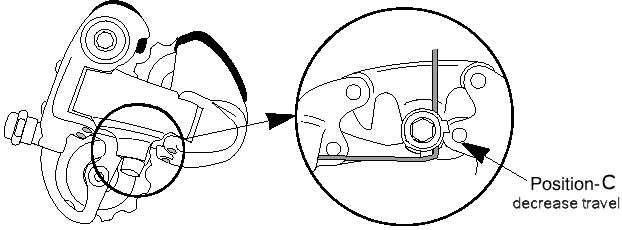
Unlike the JTek Shiftmate adapters and the Dura-Ace modification, the other alternate cable routings are not standardized. To get the indexing to match the sprocket spacing, you will have to check and readjust the place where the cable attaches.
This article links to tables showing combinations of shifter, rear derailer and sprocket spacing and adapter (if used) which achieve correct indexing. Here's how to use the tables.
How close to these does indexing have to be? Try and see. You could try iffy combinations but shifting is likely to worsen more quickly with wear.
Combinations with longer cable pull at the shifter are likely to work best. Combinations with no adapter or a decrease-ratio adapter are likely to work better than ones with an increase-ratio adapter. Combinations using Shimano derailers with the "Hubbub" cable routing are likely to be less accurate than others.
Sheldon Brown, founder of this Web site, compiled the table of sprocket spacings on which much of the work here is based. He also described some nonstandard combinations. Chris Juden, of the Cyclist Touring Club (U.K.), explored nonstandard combinations systematically, and has published information about them, as have Art's Cyclery. JTek Engineering and Quality Bicycle Products (available through bike shops) have been very helpful in providing technical data on their products.
Last Updated: by John Allen