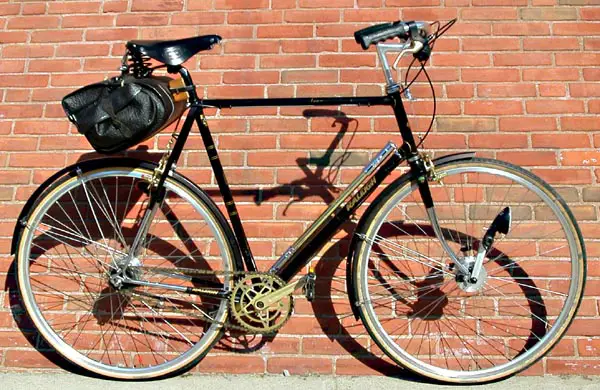
The Shimano Nexus 4-Speed Hub

|


The Nexus 4-speed hub's availabilty is in question, at least in the USA. We provide information about it here to assist people who would like to keep this hub in service.
Another article on this site covers maintenance issues that apply to 4-, 7-, 8- and 11-speed Shimano Nexus and Alfine hubs:
There are also articles on this site more generally about
Read those articles along with this one. For more-detailed advice on installation of sprockets and setting the gear range, see the section on sprockets in the main article on internal-gear hubs.
Because the four-speed hub only gears up, it needs a smaller chainwheel and/or larger sprocket than most other internal-gear hubs to achieve a desirable range of drive ratios:
| Ratio | 1.000 | 1.244 | 1.500 | 1.843 | ||||
|---|---|---|---|---|---|---|---|---|
| Step | 24.4% | 20.6% | 22.9% | |||||
| Ratio | 0.750 | 1.000 | 1.333 | |||
|---|---|---|---|---|---|---|
| Step | 33.3% | 33.3% | ||||


The four-speed hub has planetary gearing with a unity ratio and three increase ratios. Its operation is very similar to that of gears 5 through 8 of the Nexus 8-speed hub. A more detailed description is provided in another article on this site.
The four-speed hub was (and in some countries still may be) available in a version with a coaster brake, and a freewheeling version which could optionally host an external Shimano Rollerbrake. There is a page on this site with detailed information about Rollerbrakes.
The internal mechanism of these hubs is complicated, and the usual repair is to replace it in its entirety. We have rebuilding instructions for both the freewheeling and coaster-brake versions of the hub, translated from the German versions, which were the only ones we could find online. The procedure given does not include information on timing the compound planet gears. Thanks go to Patricia Morris for pointing this out and for the photo below. The red arrow points to the timing mark. The marks on all three gears must point directly outward.

The right-hand hub bearing cup is vulnerable to damage from water contamination. Better lubrication is recommended to forestall this problem and to make cleaning and rebuilding easier.
Shimano lists the overlocknut distance of the 4-speed freewheeling brake hubs as 130 mm, as sold -- see Shimano's overlocknut spacing chart -- though also 123.5 mm and 127 mm, in its rebuilding instructions for the freewheeling/Rollerbrake version. If not using a Rollerbrake, it is possible to reduce the overlocknut distance by using a thinner lockwasher, as described on the Rollerbrakes page.
The 4-speed hub uses the same cassette joint as the 7-speed hub.The shift lever for the 4-speed hub may be unavailable, but the cable pull for the shift levers for Shimano 7-speed and 8-speed internal-gear hubs is close enough in the lowest 4 gears that these shifters can be used with the 4-speed.
The 4-speed hub has been sold with an automatic, electronic shifting system.
Information on the Shimano site about all these hubs may be found with this search. The table below includes rebuilding information not available on the Shimano site. The parts lists and exploded drawings are in the list which the links bring up -- same as the seach just mentioned.
| Model | Features | Documentation |
|---|---|---|
| Nexus SG-4C35 | Coaster brake | Rebuilding Instructions Parts list, exploded drawing (Note: two versions, with one, and two, non-turn washers). Installation instructions |
| Nexus SG-4R35 | Freewheeling/Rollerbrake | Parts list, exploded drawing
Installation instructions Rebuilding instructions: see SG-4R31. |
| Nexus SG-4R31 | Freewheeling/Rollerbrake | Rebuilding instructions |
| AUTO-D | Electronic shifting 4-speed hubs | Parts list, exploded drawings for coaster-brake and freewheeling/Rollerbrake version |
In some cases, it is possible to convert an existing bicycle to use a Nexus hub. Sheldon had a very nice 1970's Raleigh Competition racing frame which he converted into a Nexus 7-speed.
Shimano Tech Tips -- structure and function, troubleshooting charts etc. |
|---|
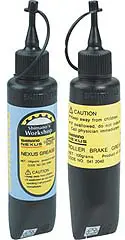 Shimano Nexus lubricants. |
| Harris Cyclery carries Nexus-equipped bicycles from several manufacturers, including: |
Breezer Bicycles |
Aaron's Bicycle Repair, Seattle, Washington, USA -- specializes in internal hubs |
Hubs to upgrade existing bikes |