| Accessories | Bicycles | Parts | Specials | Tools | View Cart |
|---|


From the WW I era to the 1970s, U.S. made bicycles, often of very high quality, were built to rather different standards than those that prevailed in the rest of the world. These bicycles used different standards for bottom brackets and cranks, frame tube diameters, seatposts, pedals, headsets and handlebar stems.When the 1970's bike boom brought large numbers of European (and later, Asian) bikes to the U.S., the older American dimensional tolerances went into retreat, and were increasingly relegated to department store bicycles, such as Huffy and Murray. People began to associate the American dimensions with these low-end bikes, and to forget that many high-quality machines had been made to these standards. While the European bikes were undeniably lighter and faster, the better American bikes were made with a greater emphasis on durability and ruggedness.
BMX bikes are still largely made to American dimensions, and the BMX segment is one of the key sources for American sized parts. The early ancestors of the mountain bike were based on older American "cruiser" frames, and many early purpose-built mountain bikes used these standards.
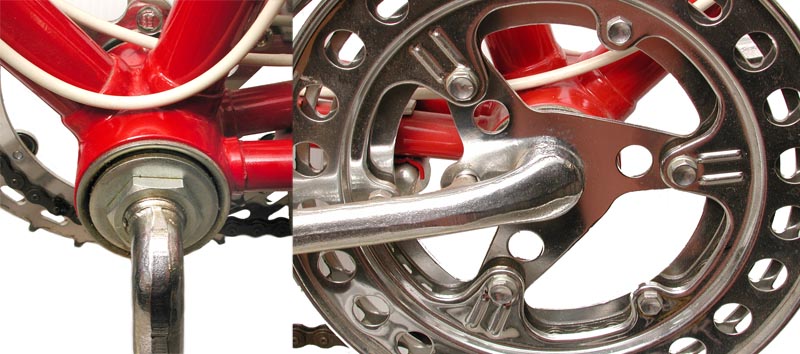
The most distinctive part of this type of bike is the one-piece steel crank. The better ones are a solid forging, incorporating the left arm, axle, and right arm in a single piece of steel. These are the strongest cranks available. This is what makes them popular for BMX and children's bikes that are subject to rough usage. They are also the only type of crankset that can be serviced with ordinary household tools...all you need is a large adjustable wrench and a screwdriver.
Interchangeability
There are two major types of one-piece crank sets, differentiated by their threading. The more common size uses 24 threads per inch, but some bikes, particularly older U.S. made Schwinn and Mongoose models, use 28 threads per inch. No part of the bearing assembly is interchangeable between threadings.
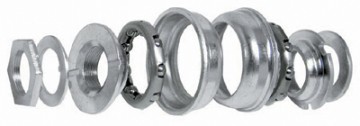
The pressed-in cups are also a different size. It is usually a good idea to buy a whole set (cones, cups, retainers) if there is serious wear to any of the parts. These are not expensive. 24 tpi cranks (with the exception of Tange brand, which use #64 9-ball)
use #66 retainers, with 10 5/16" balls28 tpi cranks use #64 retainers, with 9 5/16" balls.
Note: any frame that will work with one of these sizes will also work with the other. The compatibility issue is with the actual one-piece crank, not the frame.
UPDATE: There are now cheap dept. store bikes that have a smaller diameter one piece bottom bracket shell. The BB parts we sell will not fit this new, small diameter shell.
![]()
If you wish to upgrade a bike built for one-piece cranks to use modern 3-piece "cotterless" cranks, you need a "conversion kit." This consists of a special bottom bracket axle and associated bearing parts that can be pressed into a one-piece-crank type frame.
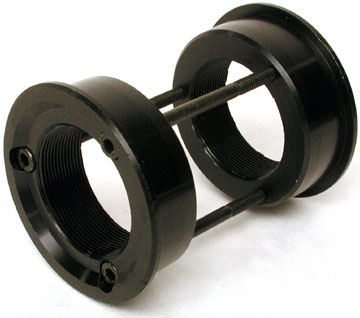
These beautifully machined aluminum bushings fit into the shell of a one-piece-crank bottom bracket, and are threaded to accept a standard threaded bottom bracket, normal 68 mm width. 3 long CrMo bolts connect the two bushings to one another for a secure mounting.This saves weight, improves shifting, and allows the use of modern clipless pedals.
Be the first kid on your block to put a Dura-Ace crankset into your Schwinn Varsity!
American-style bikes generally are built with thinner tubing than foreign ones. The compensate for the thinner diameter by using tubing with thicker walls. The frames tend to be plenty sturdy, but a bit on the heavy side. The thick-walled tubing lended itself to welded construction, which was not possible with thin-wall tubing before the development of TIG welding and similar processes.
Since American style frames use smaller tubing diameters, they also need to use skinnier seatposts. The most common sizes are 7/8" (22.2 mm) and 13/16" (20.6 mm)
Wald 13/16" (21.15 m) Seatpost, 15 inches $9.95
Many older U.S. made bikes take this thin size. Unfortunately, there's very little choice in this diameter. This Wald galvanized steel seatpost is plenty long, but if fully extended, a heavier rider may well cause it to bend.The top end is enlarged to 7/8" to fit standard saddle clamps.
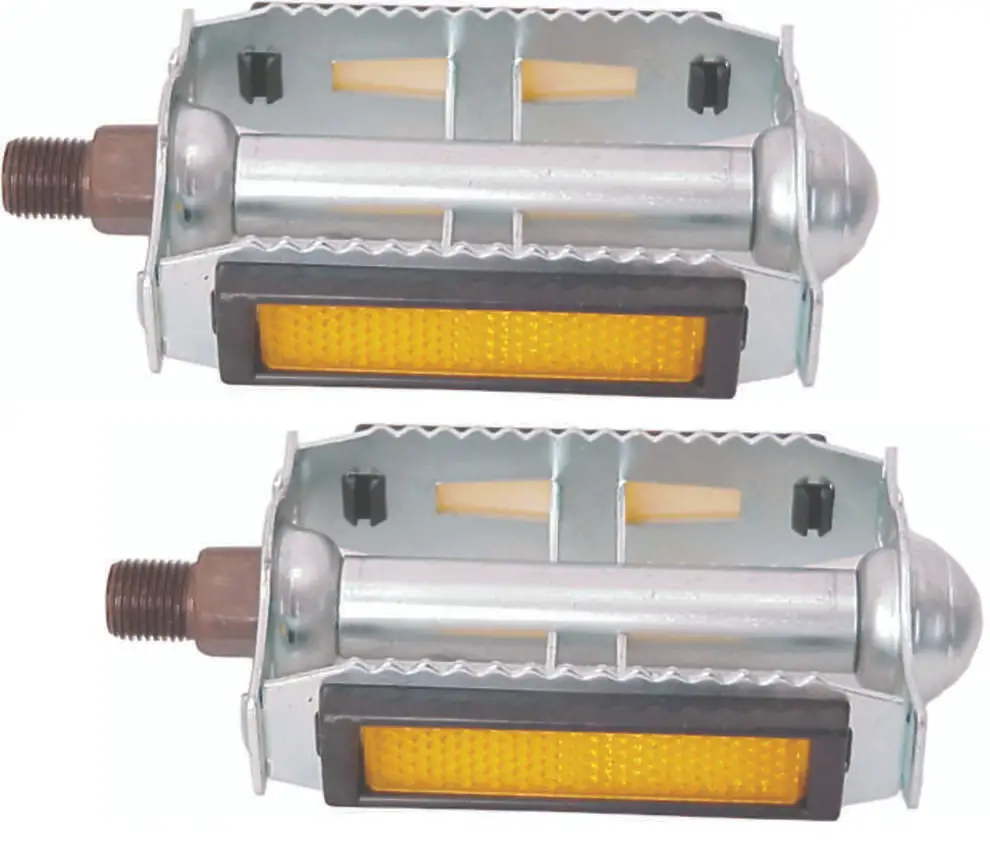
Since one-piece cranks have to be able to fit through the bearing cones for assembly, the cranks cannot be as thick as three-piece cranks. As a result, they have to use a smaller diameter pedal thread, 1/2" instead of 9/16".
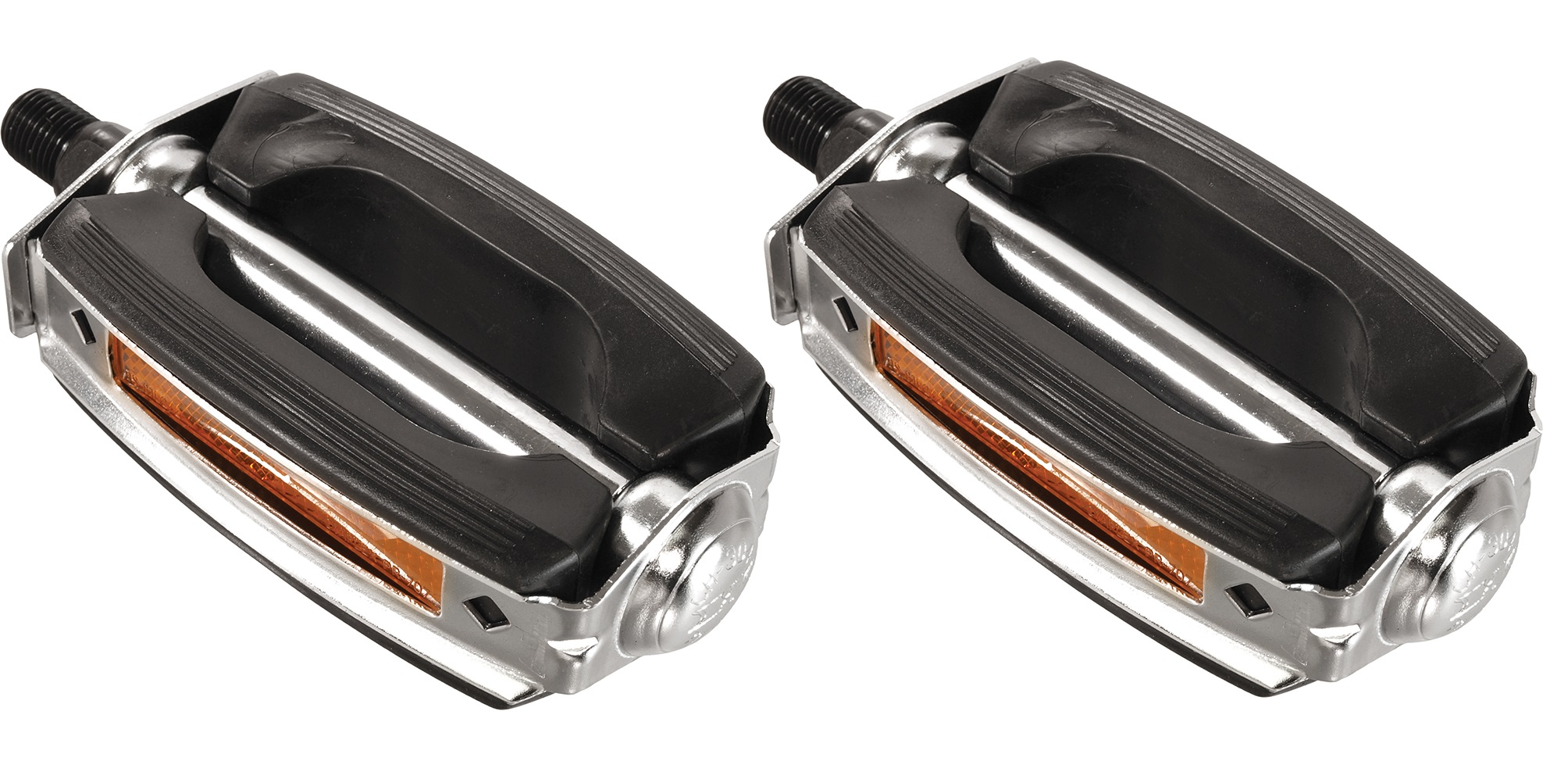
A classic traditional rubber block pedal, with serviceable bearings, Japanese quality.
A first! 1/2" track pedals!Be the first kid on your block to put track pedals on your Schwinn Varsity!
Silver color.
You can attach any standard toe clip, and the pedals have slots for toe straps.
Solid, alloy unibody construction.Nicely finished, silver color.
You can attach any standard toe clip, and the pedals have slots for toe straps.
Aluminum cage and body.
You can attach any standard toe clip, and the pedals have slots for toe straps.
These adaptor bushings have a male 1/2"-20 thread to fit into your one-piece crank, and a standard 9/16"-20 female thread that will let you install standard 9/16" pedals, even modern clipless pedals.These install with a standard 6 mm Allen wrench.
American-style bikes use the same headset threading and diameter as ISO standard (British) headsets, also the same 26.4 mm fork crown race size, but the frames have larger diameter head tubes.
Threaded Headsets (Yellow background indicates interchange problem) Size
Steerer O.D.Stem diameter
Steerer I.D.Crown race
Inside diameterFrame Cup
Outside DiameterThreads
Per inchNotes BMX/ O.P.C. bikes .833"
(21.15 mm)26.4 mm 32.7 mm 24 Older American Bikes 1" ISO Standard (25.4 mm) .875"
(22.2 mm)26.4 mm 30.2 mm 24 Modern standard size 1" J.I.S.(25.4 mm) .875"
(22.2 mm)27.0 mm 30.0 mm 24 Older or lower-quality bicycles from Asia Odyssey Dynatron BMX/OPC 1" headset $18.95
![]()
American-style bikes have thicker steerer tubes than Euro bikes, so they take thinner stems. The usual diameter is 21.15 mm vs the British 22.2 mm size. The stems listed below are this size. Sorry we don't have more to choose from, but these are getting scarce.The handlebar clamp diameter of American stems is usually the ISO standard size, 1"/25.4 mm, or, in BMX applications, 7/8"/22.2 mm, so matching bars to stems is not commonly a problem, as long as the stem fits the steerer.
Alloy/Steel Stem SM242 $24.95
Ideal upgrade for your Schwinn Varsity or other older bike that needs the 21.15 quill size.Aluminum upper section to keep the weight down, with strong steel quill.
Forward Exension (reach) 3" (80 mm) Weight: 440 grams Clamp fits ISO standard 1" (25.4 mm) handlebar center.
"Swan"-Type High-Rise Stem SM245 $19.95
These are all-steel with a short 65 mm extension. These are heavy, but if you want your handlebars really high, this is what you need.
Forward Exension (reach): 2 1/2" (65 mm) Length: Quill is 10" (254 mm ) tall. Weight: 500 grams Clamp fits ISO standard 1" (25.4 mm) handlebar center.
21.15 mm Stem Raisers SM247 $19.95
A stem raiser fits into the steering column in place of your present stem, and secures with a wedge bolt in the normal manner. The upper part of the stem raiser sticks out above the steerer, and is bulged out so that you can insert your original stem. The bottom of the original stem winds up a bit above the top of the headset, so you gain several inches of height.
![]()
Note: Steerers are butted at the bottom, so the hole in the steerer is constant-diameter until near the bottom, then the walls taper inward in the butted section. It is vitally important that the stem extender (or stem) is not inserted so far that the wedge is installed where the steerer is narrowing, or it could come loose unpredictably. This is sometimes a problem on smaller frames if you try to insert the stem or a stem riser too far down into the steerer.