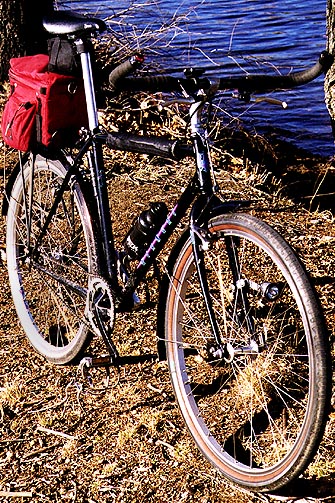
Leather Saddles
|
Translation of this article (earlier version):
Russian  |

|

updated by John "Full Immersion" Allen

|
Translation of this article (earlier version):
Russian |
|
What we promote, we ride. Two tandem teams, four leather saddles:
Jacob and John Allen (foreground),
George and Sheldon Brown (background) ca. 1995

"Revolutionary" saddle designs come onto the market every year, and these new technologies have much to offer for many riders. Nevertheless, many others may be best served by a technology that has not changed substantially since 1880, the tensioned leather saddle.
From the dawn of history up through the early 1970's, virtually all good-quality bicycles came with leather saddles.
In the early '70's, plastic saddles started to make major inroads, and today only a few top-end touring bikes come equipped with leather saddles. Does this mean that leather saddles are obsolete? NO! leather saddles are no more obsolete than leather baseball gloves!
Plastic saddles have four advantages over leather ones:
Leather saddles have three advantages over plastic:
They are not for everyone. Leather saddles are substantially heavier than synthetic ones, and they do require breaking in. A new leather saddle is quite hard and rigid, and it takes several hundred miles to break one in. In addition, leather saddles require care, and can self-destruct if not properly maintained. People who slide forward and back on the saddle a lot may find a leather saddle uncomfortable because of the metal frame at the back and nose at the front.
Most of the cyclists on the road today became cyclists after the disappearance of the leather saddle as standard equipment on new bikes, so they have no experience with leather saddles. Many others may have had a leather saddle on their first bike, but never received any instruction in the proper care and break-in of a leather saddle. As a result, many otherwise knowledgeable cyclists are woefully ignorant about leather saddles. They have heard that a well broken-in leather saddle is more comfortable than a plastic one, but they have an exaggerated idea of how difficult and painful it is to break one in.
A leather saddle, like a good pair of shoes or a baseball glove, softens with use, and molds itself to fit a particular person's shape. Whatever part of your rear end pushes hardest on the saddle causes the corresponding part of the saddle to soften and stretch to relieve the uneven pressure, until the saddle accommodates perfectly to your own particular tush.
Most plastic saddles use closed-cell foam to provide some softness, but the foam and the plastic undercarriage of the saddle can only be shaped to fit an "Average" bottom, not yours. Closed-cell foam is an excellent heat insulator, so this type of saddle is a particular problem in hot weather, because it holds heat and moisture.
In addition, when you sit on foam, the foam under your "sit bones" compresses right away, so other foam winds up exerting pressure on (ahem!) soft tissues that were not made for this.
Also, a saddle with a fabric covering can wear clothing quickly.
Leather saddles, by contrast, are particularly good in hot weather, because they use no insulating foam, and can breathe. This makes them cooler and allows perspiration to evaporate through the saddle, so they are less likely to cause chafing and saddle sores. Even though it breathes, the leather is smooth, reducing chafing and wear to clothing.

Leather saddles are not for everyone, but in my opinion, they are the best choice for the many serious cyclists. Racers, particularly those who compete in short events, should stick to plastic because of weight. People who ride a lot in the rain without fenders should stick to plastic because excessive wetness is bad for leather. People who are unwilling to do routine maintenance should stick with plastic, because leather does not thrive on neglect. People who must ride in light-colored clothes should avoid leather saddles, because they can stain clothing.
On the other hand, leather saddles are the best choice for the recreational/sport rider, and the overwhelming choice for the long- distance tourist. The occasional weekend pootler is also a good prospect for leather, because an un-conditioned rider has a more delicate rear end and sits down harder on the saddle than a hard-pedalling sport rider.
Leather saddles are not the easiest things to sell. Many people have the idea that they are for masochists, based on the exaggerated tales they have heard about how hard it is to break them in and how uncomfortable they are supposed to be for the first few thousand miles. A bicycle-shop salesperson who takes the time to explain how to break a leather saddle in can win a customer's undying gratitude. Few shops take the trouble to push leather saddles, and people will know that the shop is going against the "conventional wisdom". If the shop succeeds in making the sale, and gives good break-in instruction, the customer will know in a couple of months that it gave good advice, when others were taking the easy way out and pushing the trendy plastic product.
You can test the fit of a saddle by placing it on the edge of a table -- the saddle will sit level on its rails -- and sitting on it. The main issue is whether the rear of the saddle is wide enough to support your sit bones (ischial tuberosities of the pelvis). Women generally need wider saddles, though widths for men and women overlap.
Brooks is the brand most often seen in the USA. Brooks saddles are available in many different widths and styles. The ones shown below are representative of the main types.
The Brooks B17 is a medium-width saddle which generally works well for sport cyclists. Several variations are available, including a somewhat wider women's version. This saddle, like all Brooks saddles except the racing models, has bag loops at the rear for a touring bag. There is even a child's version, the Colt.
Brooks B17 saddle

A similar, sprung model, the Flyer, can increase comfort and take the roughness out of the ride of a small-wheel bicycle. A sprung saddle also makes good sense for the stoker on a tandem, who cannot see bumps ahead to unweight the saddle.
Brooks Flyer saddle

Racing saddles, such as the Brooks Team Pro, do not have bag loops. They are of thicker leather and are best for cyclists who ride with the handlebars lower than the saddle.
Brooks Team Pro saddle

A narrower saddle, the Swallow, is especially good for cyclists who have problems with legs chafing against the wings of the saddle. The Swallow has bag loops; a similar model, the Swift, is the lightest Brooks saddle. It has titanium rails and lacks bag loops.
Brooks Swallow saddle

Wide saddles such as the Brooks B66 (below) are most suitable with an upright riding position, which places most of the cyclist's weight on the saddle. This saddle, like those many on classic English three-speed bicycles, has a four-wire undercarriage and must be used with a "seat sandwich" double-rail adapter (Breezer makes one and Harris sells it) or a plain-tube seatpost and the clamp assembly shown in the photo of the saddle. The B67, with a standard two-wire undercarriage, is also available. The B72 is similar, but has only short loops of wire instead of springs. There are other Brooks saddles with more elaborate springing.
Brooks B66 saddle

If a leather saddle is not oiled, and especially if it is allowed to get wet with water repeatedly, perhaps even ridden while soaked, it will eventually crack and disintegrate. The low-quality leather saddles that came on inexpensive ten-speeds of the sixties and seventies would also often go out of shape under such conditions.
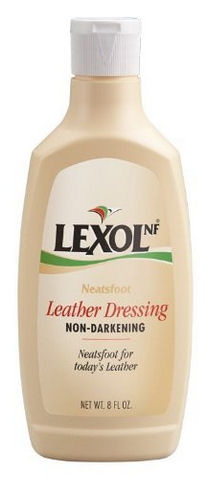 The easiest and fastest method to break in a new saddle is with a liquid leather dressing, such as neats-foot oil, Lexol, seal oil (a French favorite) or baseball glove oil.. These products are available from shoe stores and sporting-goods stores, and over the Internet. There are probably lots of other liquid oils that would work as well. Race Across America pioneer Lon Haldeman uses SAE 30 motor oil, but his saddles tend to wear out after only 300,000 miles or so (according to Cyclist magazine).
You can just pour the oil on and rub it in by hand, or for a more drastic approach, you can actually soak the saddle. The easiest way to soak a saddle is to turn it upside-down on a sheet of aluminum foil, then form the foil up around the saddle for a snug fit. Pour in a whole 4-ounce can of neats-foot oil or whatever oil you prefer, and let the saddle soak for 30 minutes to an hour. Pour the remaining oil back into the can, and wipe the excess oil off with a rag or paper towel. Install the saddle onto the bike, put on your black shorts, and ride. Even the most recalcitrant saddle (the thick-skinned Brooks Professional) will be substantially broken in within 200 miles or so.
The soaking technique is best for thick, hard-to-break in saddles such as the Brooks Professional. For most leather saddles, the pour-and-rub technique is adequate. A saddle needs baptism by immersion only once. After that, some oil should be poured onto the saddle and rubbed in by hand every few weeks. Once the saddle has become soft and comfortable, it is only necessary to oil it lightly every few months to keep it from drying out.
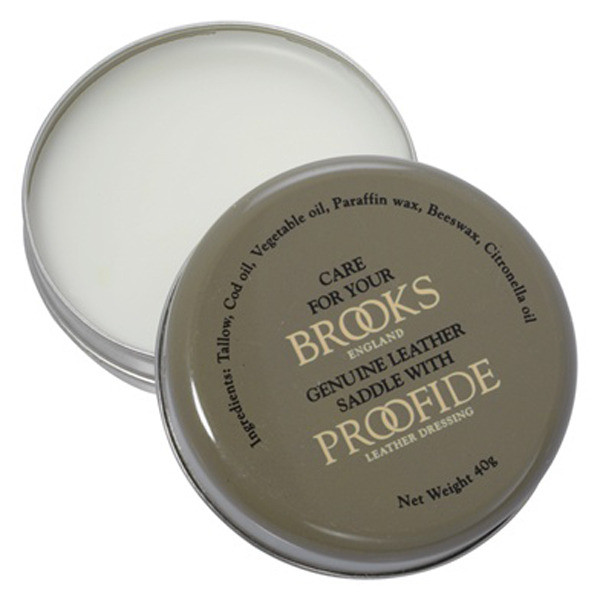 Paste- or wax-type leather dressings, such as Brooks Proofide, Sno-Seal, and saddle soap will work, but it takes much, much longer to break in a saddle that way. They will absorb faster into the leather if it is warm -- in the sun on a hot day, or in a warm oven. Temperatures up to about 50° C (120° F) are safe. Higher temperatures can cook and ruin the leather.
Products containing animal fat, and in particular, one called Mink Oil, can eventually allow mold to form, and also are more likely to make the saddle tasty to mice and squirrels.
A reader recommends that if a saddle has become too soft through long immersion, it should be scrubbed from the bottom with soap and water. Try at your own risk!
Many leather saddles are dyed black. Oiling the saddle will partially dissolve the dye, which will stain your clothes. This is why cycling shorts are black. Wear light colors at your own risk! If you must wear day-glo pink shorts, put a seat cover on the saddle.
Light colored leather saddles, such as the Brooks "Honey" models, will be darkened by any treatment you apply, but don't stain clothing as much.
Note: treatment and break-in of leather saddles is not an exact science, and there are those that claim that some of the products I've listed are harmful to leather. If absolute safety is your primary concern, using Brooks Proofide according to directions is probably the best approach...but you may find that the break-in period is unnecessarily long with this approach.
The worst thing you can do is to neglect the saddle and allow it to dry out and crack.
I've been riding leather saddles since the early 1970s and heard about
the neat's-foot oil trick about 40 years ago. I’ve done it on a couple
of saddles and have purchased used saddles that have had this
treatment. I no longer recommend it, as I think it has too much
potential to ruin saddles, especially when one gets caught in the rain
on long rides. The problem is that neat's-foot oil can work too well,
giving the saddle the flexibility of a glove or purse. While this is
initially quite comfortable, the saddle can stretch way too much where
pressure is applied, especially if ridden when soaked. Using
Proofide or Dubbin on the top of the saddle, and a beeswax-based
treatment on the bottom of the saddle does take longer to break the
saddle in, but it tends to stop at the perfect combination of
flexibility and support, whereas saturating the saddle seems to break
down the fibers that give the saddle its stiffness. Since Proofide
has become so expensive, I’ve switched to Pappy’s Dubbin and Bee Dry
to maintain my leather saddles. [Sno-Seal is another beeswax-based treatment -- John Allen]
Certainly, everyone’s experience will be slightly different, and rider
weight, distance, amount of wet weather riding, and even the inherent
uniqueness of each leather saddle will likely yield different results,
but I now suggest that people take the longer, but more predictable
approach to breaking in leather saddles, so they don’t end up with
what some derisively and crudely describe as an “ass hatchet.”
Steve Barner
Brooks leather saddles have a rather short front-rear adjustment range and should be used with a seatpost that has setback. On a frame with a high seat-tube angle, a seatpost with a long setback may be needed unless the cyclist prefers a "triathlon" riding position. A saddle with a plain-tube seatpost may be adjusted over a wider range by flipping the clamp over to place the seatpost at its front or rear.
Saddle tilt is important, and in this regard, a microadjustable seatpost is preferable to one with a ratcheting angle adjustment. A microadjustable seatpost can be used with a four-wire saddle and the Breezer double-rail adapter ("seat sandwich").
Breezer double-rail adapter
Most leather saddles have a tension-adjusting nut located under the nose of the saddle. Fortunately, this nut usually requires a special wrench, so most people leave it alone. In almost every case that I know of where someone has tried to adjust the tension with this nut, the saddle has been ruined. My advice is to leave it alone.
If a leather saddle gradually becomes too soft and too wide after many thousands of miles, it is sometimes useful to punch a few holes in the bottoms of the side flaps and lace them together under the saddle frame. This allows the width and firmness of the saddle to be adjusted to the rider's taste. Some models come with a row of holes along the lower edge of the side flaps, for this very purpose.
I realize that this sounds like a lot of trouble, but most cyclists who take the trouble find it well worthwhile -- in the end.
Back when leather was the only game in town, good bikes came with good leather saddles, and cheap bikes came with cheap leather saddles. There is quite a difference. For one thing, good saddles are made of thick, high-quality leather. In addition, leather, like wood, has a natural grain pattern. When saddle tops are to be cut out of a hide, the cutter has a choice. The cheap way is to get the largest number of saddle tops from a given hide with the least wastage of leather. The high-quality way is to cut the saddle tops in such a way that the grain runs straight down the middle of the saddle.
The cheap saddles that came on $90 bikes in the early '70's are no longer made, but their memory lingers on. Some of them could be broken in properly and give a comfortable ride, but many had the wrong grain, and went from bad to worse.
On the other hand, a good leather saddle will last for many years. It can be expensive, but it will outlast several synthetic saddles, and cost less in the long run.
There used to be many brands of leather saddles, but two names in particular stood out for the highest quality: Brooks of England and Idéale of France. Brooks is still very much in business, and sells by far the most leather saddles in the USA. Idéale saddles are again being manufactured after many years of stoppage. A man has bought up the original tooling, searched out some of the old workers to get their experience and he is now manufacturing the saddles as they used to be made.The site is available in English and French and provides a lot of interesting historical and technical information. (Thanks to Geoff Beaman for this information).
Harris Cycle carried Brooks and Gilles Berthoud, as well as a new brand, Rivet, made in the USA.
Elton Pope-Lance from Harris Cyclery puts saddles on display at a bike expo.

User feedback follows. Please remember that each person commenting describes experience with only one saddle, or a few saddles, and that different models of the same brand may be very different. Production may also vary with time. Please don't overgeneralize.
First I (John Allen) would like to describe my own experience:
I've used leather saddles since the early1970s -- first, a Brooks B72 (wide) on a Raleigh three-speed, then a couple of cheap Wrights saddles, which became misshapen. I acquired my first Brooks B17 in the early 1980s: it's the one I repaired after 30 years, as already described. I've bought most of my leather saddles at bicycle flea markets or from other bicyclists who found them unsuitable for one reason or another. As Sheldon says, they aren't for everyone.
The Swift and Swallow models are narrower than the B17 and too narrow for me.
I have an Idéale model 92, with lightweight aluminum undercarriage, pre-softened, Daniel Rebour treatment ("Rodée main selon DRebour"). I bought this saddle new. This saddle must be used with a plain tube seatpost, but the saddle clamp has a microadjustable feature. After a number of years, the undercarriage began to slip, so I coudln'tt keep the nose up at the angle I want. I describe how I repaired this saddle in a companion article.
On the back of my tandem, I have had a B72, and also a more softly sprung model, the B67, but the leather on that one had been abused when I got it, and needs replacement. On the front, I have a Brooks Pro.
On my folding bicycles, which have a somewhat rough ride because of the smaller wheels, I use the Brooks Flyer. The undercarriage of one Flyer needed a repair after about 7 years and 10,000 miles, as described. Details of the repair are in the companion article.
My son has a B72 on his mountain bike (now equipped with road tires). My wife rides a recumbent, so this discussion isn't relevant to her.
OK, enough for me. Sheldonbrown.com site owner Harriet Fell comments:
I started cycle-touring in the early 70s and from 1971 to 1979. I used a plain black plastic Unica saddle.
That's  what my friends "in the know" recommended. During that time I cycled across England, Scotland, Wales, Southern Ireland, Greece, and all over France. I did Paris-Brest-Paris in 1975 and the Randonnée des Puys (300 km and 4000 meters of climbing) in 1976. I cycled up White Mountains in New Hampshire, Green Mountains in Vermont, and high cols in the Alps and Pyrenees. I got occasional saddle sores but I never felt anything was wrong with my saddle; it was the only one I knew.
When I married Sheldon in 1979, he replaced my Unicas with Brooks saddles (a Brooks B17 on my Holdsworth and a pre-softened Brooks Pro on my fixie Bottecchia). I have been riding Brooks saddles since then so I have a few broken-in saddles that were really comfortable for many years. I did not ride nearly as much during these years as I had before. After childbirth in 1981 and 1983 I started to find the saddles irritating and I tried a women's saddle. I think it was a Terry. The dip eliminated the irritation but the saddle always pinched a nerve causing sciatica-like symptoms so I gave up trying to use it.
This summer I started cycling longer distances again. There are now many split or dipped saddles on the market so I started searching for one that would work for me. Debra Banks started Rivet Cycle Works after an exhaustive (and unsuccessful) search for the right saddle for her long-distance endurance bike rides.
Rivet Pearl Chestnut Chromoly saddle

I found Rivet by searching the web and the "Pearl" looked like the right saddle for me. It's similar in size and shape to my Brooks B17, it is open where it should be, it looks like it will last forever, and it was designed by Debra Banks, a long-time randonneur. I have ridden about 600 miles including a few metric centuries on the saddle since I got the saddle last month. It is comfortable, the opening works for me, and it does not pinch any nerves. It is, however, not yet broken in. I expect that someone who is larger and weighs more than I do would have it broken in by now. I will persist. I think I'll be riding and enjoying this saddle for a long time.
My "Fell" has a Vetta - simple and light. I will be replacing that too - probably with a Selle Anatomica, as that should be fairly light and not need much break-in time. Since I weigh only 120 lbs I expect it to last fairly well.
Sheldon had a preference for a Brooks Swallow on his solo bikes. I still have five bikes he set up for himself: The Brown, a Bianchi, and Mead Ranger (1916) have Brooks Swallows; a Raleigh Sports has a Brooks B17 (though the online photo shows it with a triple-sprung Brooks B73); the 1983 Repco has a Brooks Pro.I have three tandems that Sheldon made from solo frames. Two of these were originally set up as kidbacks. There is a smooth Brooks Pro on the one Sheldon piloted and a dilapidated Wrights on the other one They both have Brooks B72s for the stoker.
The third tandem has a Brooks B17 for the pilot and a Brooks B66 for the stoker (me).
The kid-kid tandem that Sheldon made has no seatpost for the pilot at this time. The stoker saddle is a Unica - probably the one I rode for so many years.
Reader Jake Kassen has tried saddles of several brands and reports:
Velo Orange Brooks Swift Knock-Off - Rivets at the wrong places. Too narrow up front, too wide in back.
Berthoud Saddle - Excellent build quality but rock hard and looks to take years to break in. Didn't want to wait it out. Returned after 20 miles.
The Selle Anatomica saddles are pretty comfortable right away for people who prefer a softer saddle. Due to their leather choice and the design they will stretch over time, particularly in humid and wet conditions or if the rider is heavy and the saddle experiences shocks from being ridden on non-smooth terrain. There is a tension adjustment but once the bolt it's used up that's the end of the saddle. I'd recommend SA saddles to people who don't ride more then a century at a time and who prefer a softer saddle.
We have another report, from reader Graham Dumas:
First off, I am in no way affiliated with Selle Anatomica, and I have received no compensation for them for this testimonial. That out of the way, I have to say that Selle Anatomica is the most comfortable saddle I've ever ridden, period. I've owned three of them since 2011, and none has ever required any break-in time or maintenance, except for tensioning, whatsoever. I recommend them to anyone who will listen, asterisk.
Not only that, but SA has been amazing in terms of customer service. Unfortunately, I am also rather well-versed in that aspect of the company (hence the switch to Brooks). I am not (yet) a slight man. At 6' 4" and 235 lbs on a good day, I proved just too heavy for the rails on my SA saddles, which continued to bend, despite being rated to 250 lbs. SA first replaced the rails quickly, and with no issue. When that didn't work, I bought a third saddle with SA's new rail design (shortening the parallel portion of the rails somewhat and angling them, to address the bending issue). Unfortunately, that didn't work either, and, after emailing them once, SA refunded my full purchase price, without prodding from me (I was angling for a repair/replacement).
So, the asterisked version of my testimonial should read, anyone under 215 lbs who does high miles in the saddle should buy a Selle Anatomica. They are fantastic, well made, brilliantly comfortable, gorgeous, nearly waterproof, and made in the USA, if that sort of thing matters to you. Unless I'm absolutely blown away by the Brooks, I will return to SA as soon as they make a tougher rail that can handle my weight.
We welcome other reports from readers!
There is also a Dutch manufacturer called "Lepper", not widely distributed in the USA; we don't have reports on this brand.