My Peugeot "PX-7"

|
Tweet
Follow @sheldonbrowncom |

In the early 1970's, one of the lightest, fastest, most exotic stock bicycles available was the Peugeot PX-10. The frame was made of state-of-the-art Reynolds 531 tubing, with Nervex lugs, and the bike came ready to race, with tubular tires and cotterless cranks.


I've had this frame since the early '70s, and for a number of years I called it my "PX-3", because it was a 3-speed.
In 1973, when I first set it up, I had the whimsical idea of making the lightest 3-speed bike possible, using a Sturmey-Archer AW hub with an aluminum shell, which I had further lightened by attacking various internal parts with a bench grinder. It had an ancient Sturmey-Archer quadrant shifter, GB All Rounder handlebars and stem, Unicanitor saddle, Mafac brake levers and the same Universal sidepull rear and Mafac Racer centerpull front brake it has today.
It had Clément "Criterium Seta" silk tubulars on Weinmann wood-filled rims. The first time I rode it, it had an aluminum chain which was made for some non-bicycle application...and which lasted about 3 miles!
This photo was made by time exposure with the wheels spinning, using the technique of "painting with light" (using a hand-held lamp, and moving it around the camera during the exposure.) Even so, it required a good deal of computer jiggery-pokery to clean up the image.

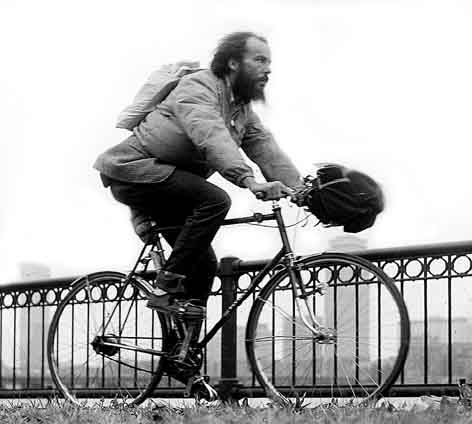
It was my primary commuting bike for several years, when I had a commute of about 9 miles. At the time the photo below was taken, in late 1974, I'd equipped it a bit more practically, with clincher tires, fenders, and a Sturmey-Archer AG hub (3-speed with built-in Dynohub generator.)
The photo below was made with an old Kodak Tourist 2 1/4 X 3 1/4 folding camera, using a rubber bulb shutter release which I rolled over with my front tire to trip the shutter.
For quite a few years, I had it set up as a "PX-4" with a 4-speed Sturmey-Archer FM medium-ratio hub. Somehow I never much liked the FM hub, and I didn't ride the bike as much as I had formerly done.
When the Shimano Nexus 7-speed hub became available, I bought one and installed it. This was a considerable improvement over the FM. In addition to being more efficient, it has a very nice spread of gears. I like it very much indeed. The hub came with a "Rollerbrake ®" (drum brake), but this was a separate module, and I chose to leave it off, since it weighs about 1 1/4 pound (over half a kilo) which is rather heavy for a brake, especially since I only very rarely use my rear brake. I find the old Universal 61 sidepull quite adequate on the rare occasions that I use it.
The "RapidFire" shifter was intended to mount underneath the right side of a conventional upright handlebar, but if I'd put it on the right side of these bars, the cable routing would be bad. Instead, I mounted it on the left side, where I can operated it easily with my left thumb. This provides a smooth and neat cable routing.

This bike has "bull-horn" handlebars from an old time-trial bike, but with BMX-style brake levers on the middle of the bars. It's sort of like a MTB bar with bar ends, except rather narrower, and the "bar ends" are longer.
When I installed these bars, I found it a bit scary to go fast with my hand so far from the brake, so I rigged a second brake lever. This lets me use the front brake either from the straight or from extended portion. I made a special yoke for the front brake, which has a cable stop with an adjusting barrel, instead of an anchor bolt. There is a single cable running in housing from the ærobar brake lever, looping down so that it comes up to the yoke from below. When the ærobar lever is squeezed, this housing pushes up on the yoke from below. The cable runs normally from the yoke to the normal brake lever. One of the levers has an anchor bolt in it, to secure the plain end of the cable.
The levers on the middle section of the bars are freestyle-type levers, which have a "stopper" button, allowing them to be locked up to serve as a parking brake. This handy feature has been included on several of my bikes. It helps keep the bike from falling over when it is leaned up against a wall or other object. It also provides a bit of protection against opportunistic thieves when doing quick errands in low-risk areas.
