
Sheldon Brown's
Bicycle Glossary N - O

|


1 Newton = .2248 pounds
An unofficial metric unit of force is the kilopond or "kilogram of force." This is the force exerted by the weight of a 1 kilogram mass in normal earth gravity, and is equal to 9.81 Newtons or 2.2 pounds.
The "kilogram of force" is a disreputable unit, abhorred by pedantic purists. Nevertheless, it is commonly used in the bicycle industry, particularly when dealing with spoke tension, since the most popular tensiometer is calibrated in these units.
This site includes a Nexus Gear Hub Technical Page and an on-line version of the Nexus 8-speed Service Manual.
In fact there is no such standard gear numbering system, nor should there be, because some gears put the chain at bad angles, and should not be used.
I know of 4 different "systems" for numbering the gears of a 10 speed:
When discussing issues related to the function of the derailers, it is better to refer to "the second largest rear sprocket" or "the middle chainwheel".
When discussing issues related to the biomechanical aspects of gearing, it is better to use terms that relate to the actual ratios, such as gain ratio, gear inches or development.

Of all the things bicycle mechanics do, adjusting spoke nipples is the one that requires the most skill and experience. If you wish to learn more about this process, see my article on Wheelbuilding.
It has very strict standards, with the intention of preventing mechanical failure and "leveling the playing field" among the athletes.
Not all of the N.J.S. standards actually relate to quality as such, but rather act to promote interchangeability of parts and tools.
N.J.S. threading and sizing standards are generally the same as for Campagnolo track parts.
 The style of handlebar used on most English 3-speed bicycles. This is a fairly narrow bar with a slight rise, grips nearly parallel to the frame.
This design was formerly associated with the North Road Cycle Club, north of London. It is a reversible design, most often used in the upright position, but quite serviceable in the dropped position as well, for a more aggressive riding position. In the reversed position, it resembles a Moustache handlebar, but with sharper bends and a bit more drop.
The North Road handlebar is most commonly seen on English three-speed bicycles -- and usually in combination with a very short stem extension. The result is "tiller" steering -- that is, the grips are even with the steering axis or behind it. With tiller steering, controlling the bicycle with one hand off the handlebar is difficult. The cyclist's weight, and deceleration due to light braking or road bumps, make the cyclist's hand push the end of the handlebar forward. It is necessary to tense the muscles of the back to prevent turning the handlebars and losing control -- and with the entire weight of the cyclists' upper body in play, this is awkward. With a hand position farther ahead of the steering axis, the cyclist's weight, pushing forward and outward -- away from the steering axis -- tends to stabilize the bicycle. A handlebar stem with a longer extension can help solve this problem, and so can placing North Road handlebars in the drop position. If the handlebars are then too low, the stem needs to be taller as well; if too far away, a frame with shorter top tube is in order. [This paragraph added by John Allen, April 20, 2010.]
 N.R.
N.R.

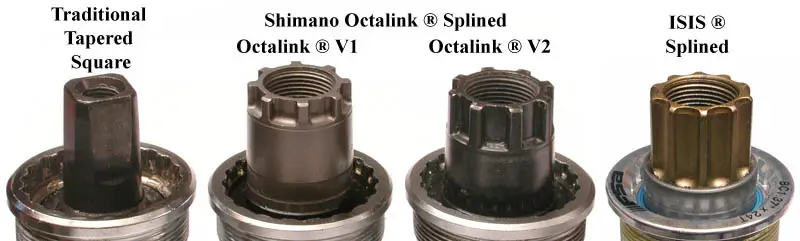
Octalink ® cranks come in one of two different spline patterns:
The V2 BBs work with FC M752, FC M751, FC M572, FC M571, FC M510-8 and FC M440-8 cranks.
Not all oil is appropriate for every use. Don't use cooking oil or other oil not intended as a lubricant! Coaster brakes should be lubricated using high-temperature grease; some internal-gear hubs also are intended for grease lubrication. Motor oil is generally not suitable for use on bicycles because it contains detergents which otherwise cause it to wash out if not replenished continuously by an oil pump. If motor oil is used on a bicycle chain, the chain will squeak the next day! [This section added by John Allen, April 20, 2010.]
See also Grease and my article on chain lubrication, which describes many different lubricants.
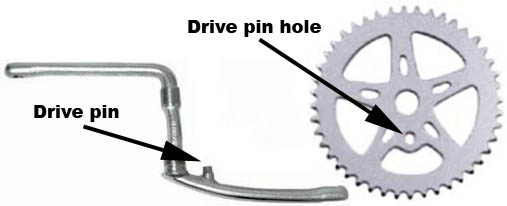 A one-piece crank (OPC) consists of a single steel forging which constitutes the left crank, axle, and right crank in a single piece of steel. This type of crank set is found on older U.S. made bicycles, and many current low-end bicycles. It is also commonly used on BMX and freestyle bicycles.
One piece, or "Ashtabula" cranks are heavy but very strong and reliable. They are also much easier to work on than any other type of crankset, requiring no special tools. You can completely overhaul a one-piece-crank bottom bracket with just a large adjustable wrench and a screwdriver.
There are two different threadings used on one-piece cranks. Most are 24 threads/inch, but some, notably older Schwinn and Mongoose bicycles, used 28 tpi. The bearing retainers and cups are also slightly different between the two models. Although they both use 5/16" balls, 24 tpi units use a #66 retainer with 10 balls, while the 28 tpi units use a #64 retainer, with 9 balls. This is one application where retainers are essential, it is almost impossible to assemble a one-piece crank bottom bracket with loose balls.
One-piece cranks only fit in bicycles designed for them, with large-diameter, threadless bottom brackets. It is possible to buy adapter kits to allow three-piece cranks to be used in this type of bottom bracket shell.
One-piece cranks are made in a smaller diameter than other crank designs, so that the bearing cones can be installed. As a result, they have to use a smaller diameter (1/2" x 20 tpi) pedal thread.
The left side cone of the bottom bracket has a left thread, and uses a locknut and keyed washer to secure the adjustment. The right side cone has a right thread, and secures the chainwheel to the crank.
Back in the 1890s, this term made sense, but using it nowadays is silly and only causes confusion.
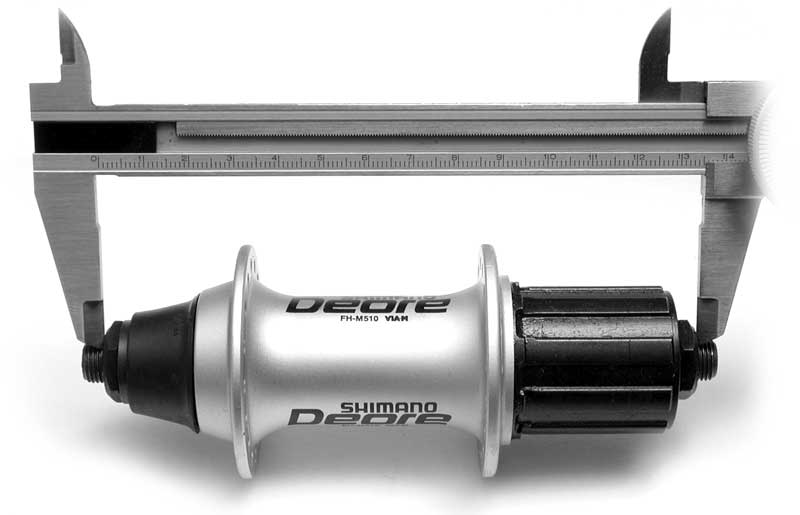
Traditional forks used 1" (25.4 mm) diameter steerers. Oversized steerers are 1 1/8" (28.6 mm) or, less commonly, 1 1/4" (31.8 mm). Details on sizes are listed under headsets.
Traditional frames used 1" (25.4 mm) top tubes, 1 1/8" (28.6 mm) seat tubes and down tubes, and 1 1/4" (31.8 mm) head tubes. When BMX racing became popular, frames built to these old standards couldn't always hold up to the rigors of BMX competition. Since the wide availability of T.I.G. welding freed designers from the need to use tubes that would fit standard-size lugs, oversized tubing became the norm for BMX frames. This design and technology were later adopted by builders of mountain bikes.
In the interest of improved chainwheel/tire clearance, some mountain bikes have "oversized" bottom brackets, with a shell width of 73 mm, rather than the standard 68 mm.
Last Updated: by Harriet Fell