About Bicycle Brakes with
Brazed-on Fittings
Brazed-on Fittings

|




|
|
This article covers all brakes which consist of two separate arms for each wheel, each with a brazed-on pivot attaching it to the frame or fork. In connection with this article, please read the lead article about rim brakes. It covers, among other things,
Most brake problems are caused by excessive friction or poor installation of the cables, not by poor setup, or poor quality brakes. Also see the article on cables for information on cable selection and adjustment of brake cables and brake levers.
Cantilever brakes have the brake shoe and cable attachment on the same side of the pivot (cantilevered). All of these brakes require special brazed-on fittings on the frame. These fittings are commonly called "studs" or "bosses."
U-brakes and Roller-cam brakes have the cable and brake shoe attached on opposite sides of the pivots, which are brazed on.
Caliper brakes attach with a bolt above the tire and have integral pivots. There are several types. The article on caliper brakes describes how to work on these brakes.

This page leads to four separate pages, each dealing with a different sub-type. Click on the heading below to go to the relevant page:
|
This is the type most commonly used since the mid 1990s. This is the only style of cantilever brake where the cable comes to the cantilever set from one side, rather than down the middle.
|
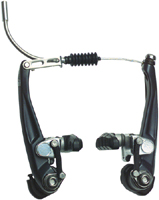 |
|---|---|
|
These were used on almost all mountain bikes made before the mid 1990s, and are still popular on touring and cyclocross bicycles. This type of brake should be used with a fender, reflector bracket or other device to prevent the transverse cable from snagging the tire if the main cable parts.
|
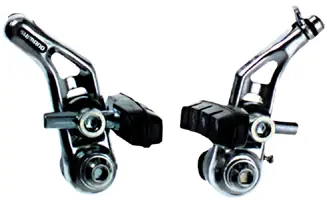 |
|
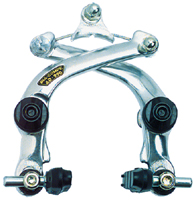
These were fashionable for mountain bikes around 1987, typically mounted underneath the chainstays.
The pivot for each brake is between the brake shoe and cable attachment, and so these are not cantilever brakes.
U-brakes have had a bit of a revival in the last few years for use on freestyle bicycles (Functionally, U-brakes are very similar to the center-pull caliper brakes popular on sport bikes of the 1960s and '70s.) |
 |
|
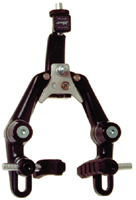
The Roller-cam brake was a predecessor of the U-brake, and had a brief vogue in the mid 1980s.
The pivot for each brake is between the brake shoe and cable attachment, and so these are not cantilever brakes.
(Unit shown is a contemporary roller-cam caliper brake.) |
 |
| Frame-Mounted Brake Compatibility/Interchangeability | |||
|---|---|---|---|
| Brake Type |
Frame Pivot Studs |
Levers | Cable Routing |
| Direct Pull V-Brake ® |
Below the Rim | Long Pull Low Tension |
Cable comes in from the side.
Lower housing stop is part of the cantilever. |
| Traditional Center Pull |
Standard Short Pull High Tension |
Cable runs down the bicycle's center line.
Lower rear housing stop on frame, |
|
| U-Brake |
Above the Rim | ||
| Roller-Cam |
|||
Direct-pull cantilevers require special brake levers. Direct-pull brake levers pull the cable twice as far, half as hard. It is not generally safe to mix and match levers/cables between direct pull and other types for this reason.
Last Updated: by John Allen