-
- Obsolete type of helmet, consisting of a network of stuffed leather straps.
-
- This refers to a wheel which is radially spoked on one flange, semi-tangent on the other.
For an explanation of this design, see my wheelbuilding article.
-
- In the days of 4- and 5-speed freewheels, 8- and 10-speed bikes were commonly set up with chainwheels that were very close in size, for instance, 46/49, or 47/50. When used with typical freewheels of the era, the difference between the two front gears was about half as large as the difference between adjacent gears on the freewheel. (One reason for this was that early front derailers couldn't handle much more than a 3-tooth difference reliably!)
With half-step gearing, the larger shifts are made with the rear derailer, and the front is for fine tuning. This allows an 8- or 10-speed set up to have a reasonable range with fairly close spacing of the gears. One downside of half-step is that it uses all possible combinations, including those that run the chain at a fairly severe angle. This was not a big deal in an 8-speed rig, but is kind of marginal for 10-speeds. Another serious disadvantage is that every other shift in the normal sequence is a double shift (front and rear derailers simultaneously). These issues are largely overcome with modern handlebar-end index shifters and narrow-spaced cassettes, but half-step requires mixing and matching sprockets these days -- no manufacturer offers an appropriate ready-made cassette.
Half-step gearing is most suitable for riding in flat terrain, where shifting is rare. It allows finer gradations to get as close to the "ideal" gear for the particular wind conditions as possible, and a wide range with even spacing. .
Modern multi-range shift patterns use larger jumps on the chainwheels to select general ranges of gears, and fairly closely-spaced 7-or-more-speed clusters for the fine tuning. This greatly simplifies the shifting pattern, allowing constant adjustment to different grades in rolling terrain, with only occasional need for double shift.
See my Article on Gear Theory.
-
- "Handle bars" on early bicycles were actually bars of solid steel. Solid handlebars became obsolete before the end of the 19th century; all modern handle "bars" are actually tubular, but the name persists.
Conventional handlebars are divided broadly into two styles: "drop" and "upright"
| Handlebar dimensions
|
|---|
Stem Clamp Size | Grip Area Size | Application
|
|---|
| 22.2 mm | 7/8" | 22.2 mm | 7/8" | Steel bars. Mainly BMX, older Mountain bike bars.
| | 23.8 mm | 15/16" | 22.2 mm | 7/8" | Obsolete British size for steel handlebars, common on older 3-speeds. This size was also used for older British steel drop bars.
| | 25 mm | | 23.5 mm | | Obsolete French size.
| | 25.4 mm | 1" | 22.2 mm | 7/8" | Standard I.S.O. size, used on the vast majority of newer bicycles with upright handlebars. This size was formerly common for steel drop bars.
| | 25.4 mm | 1" | 23.8 mm | 15/16" | Standard I.S.O. size, used on most bicycles with drop handlebars. Also used on older British aluminium upright handlebars.
| | 25.8 mm | | 23.8 mm | 15/16" | Unofficial in-between size used by some Italian handlebar makers for handlebars designed to be usable in either ISO (25.4) or Italian (26.0) size stems.
| | 26.0 mm | | 23.8 mm | 15/16" | Italian standard for drop bars, other bars made to fit Italian stems and some high-end aftermarket drop bars. This is sometimes incorrectly called "road" size.
| | 26.4 mm | | 23.8 mm | 15/16" | Older Cinelli and Cinelli copies. Cinelli changed over to 26.0 mm in 1998.
| | 27 mm | | 23.8 mm | 15/16" | Titan (obsolete).
| | 31.8 mm | 1 1/4" | 23.8 mm | 15/16" | Road oversized.
|

-
- A cylindrical, slip-on covering for the end of a handlebar, generally made of rubber or plastic, and formed to fit the hand. handlebar grips are most commonly used for flat handlebars. However, longer and thicker handlebar grips made of stiff foam rubber may be installed on drop handlebars to improve comfort. Some handlebar grips include twist shifters; see Gripshift.
-
- See stem
-
- Cloth, plastic, leather or cork tape that is wrapped around handlebars to provide better grip and some cushioning. Most commonly used on drop handlebars.
Sometimes incorrectly referred to as "handlebar ribbon." This mistake results from a translation error. (in French and Italian, there is no distinction between "ribbon" and "tape.")
-
- This term has several bicycle applications:
-
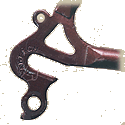
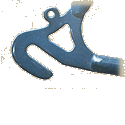
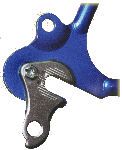
- A derailer hanger is the part of a rear dropout to which the rear derailer attaches. It is also another name for an adaptor claw.
| Dropout with built-in hanger | Plain dropout | Plain dropout with adpator claw |
 |
 |
 |
- A cable hanger is a bolt-on cable stop used with centerpull or cantilever brakes. The front cable hanger is secured by the headset, the rear attaches to the seatpost bolt.
- A chain hanger is a small braze-on mounted on the inside of the right seat stay. When the rear wheel is not installed in the frame, the chain may be routed over this fitting to keep it from flopping around.
- "Hanger" is also an old-fashioned American synonym for "bottom bracket."
-
- A motorcycle term for a bike which has no rear suspension. Some cyclists find this term offensive when applied to bicycles.
-
- Steel can be made to have different characteristics by various heat treating processes. These involve heating steel to various temperatures, then cooling it down either rapidly or gradually. Depending on the specific heat treatment chosen, steel may be either very hard and brittle or soft and flexible.
This is a very complicated technology, with very ancient roots. For many applications, such as sprockets and bearings you want a very hard surface to the part, but the inside of the part should be treated to a lesser hardness so as to avoid excessive brittleness and breakage.
-
- See: Anodized
-
- The bearing assembly that connects the front fork to the frame, and permits the fork to turn for steering and balancing.
A conventional threaded headset consists of four races plus associated parts:
- The crown race, which is pressed on to the bottom of the steerer, just above the crown.
- The lower head race is pressed into the bottom of the head tube.
- The upper head race is pressed into the top of the head tube.
- The adjustable race attaches to the steerer.
The adjustable race is secured by either a:
Threaded vs Threadless
There are two different systems for attaching and adjusting the adjustable race:
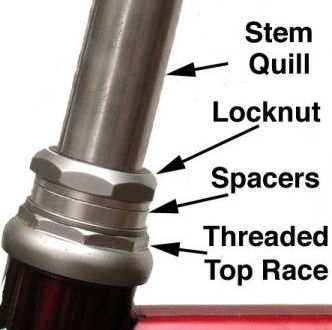
Threaded HeadsetNote wrench flats on locknut and top threaded race.
|
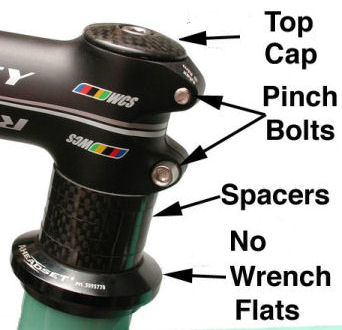
Threadless HeadsetNote pinch bolts on stem.
 |
|---|
- Traditional threaded headsets fit forks with threaded steerers. The adjustable race screws on to the steerer, and a locknut screws on after the adjustable race to secure it. There is normally a keyed washer between the adjustable race and the locknut for extra security.
- Threadless headsets have an adjustable race that slips over an un-threaded steerer. There are three distinct types of threadless headsets which adjust differently:
- "Aheadset" style threadless headsets, the most common type, require a threaded fastener, such as a Star Fangled Nut to be installed inside the steerer.
This type of headset must be used with a special handlebar stem that clamps on to the outside of the steerer, either with one or more pinch bolts
(a.k.a. binder bolts), or other means. The stem is further secured by a plastic or metal cap which is bolted to the star nut.
To adjust an "Aheadset"-type headset, the stem binder must be loosened, then the bolt that runs through the cap to the star nut is tightened, usually with a 5 mm Allen wrench. This presses the stem down against the tapered bushing that fits inside the adjustable cup. and takes up the slack in the system. The stem is then aligned with the front wheel and tightened with its binder bolts. (Once the stem binder bolts have been tightened, the adjusting bolt that goes to the star nut is under no significant stress, and may even be removed.)
- "Diatech" headsets from Dia Compe use a special pair of collars, usually mounted just below the stem and above the top race. The lower collar has a beveled, conical top surface, which fits inside of a matching bevel on the inner circumference of the upper collar.
The upper collar has a gap at one point, with a pinch bolt to squeeze the gap together. (This upper collar may also include a cable stop for the front brake, if the bicycle has a rigid fork and conventional cantilever brakes.)
The handlebar stem is clamped tightly to the steerer, preventing the upper collar from moving upward. As the upper collar is compressed by the binder bolt it squeezes lower collar downward, taking up any slack in the headset bearings.
- The YST "GeForce" headset has a collar which slips over the steerer, and is clamped to it with a binder bolt near the top of the collar. The outside of this collar is threaded, and the upper bearing race screws onto these threads. The upper race assembly is fitted with a binder bolt that clamps it tight onto these threads when the desired adjustment has been attained.
The GeForce is the only threadless headset which doesn't use the handlebar stem as part of the adjustment. These headsets may be used with any stem, either external-clamping or internal expander/wedge type.
Headset sizing
The nominal size of a headset is based on the outside diameter of the steerer. This is a source of confusion, because the steerer is not visible on an assembled bicycle. In the case of a bicycle with a traditional expander/wedge type stem, the stem shaft will be 1/8" smaller than the steerer. Sometimes people measure the stem diameter and assume, incorrectly, that this is the size headset they have.
| Threaded Headsets
|
|---|
Size Steerer O.D. | Stem diameter Steerer I.D. | Crown race Inside diameter | Frame Cup Outside Diameter | Threads Per inch | Notes
|
|---|
| BMX/ O.P.C. bikes | .833" (21.15 mm) | 26.4 mm | 32.7 mm | 24 | Used mainly on bicycles with one-piece cranks, also some early mountain bikes.
| | French 25 mm | 22 mm | 26.5 mm, 27.0 mm | 30.2 mm | 25.4 (1 mm) | Obsolete. French steerers usually have a flat filed on the back, rather than a grooved keyway as with other threaded systems. | Interchangeability note: These 5 sizes of forks and headsets all fit the same frames, since the head tube size is the same.
| 1" ISO Standard (25.4 mm) | 7/8"(22.2 mm) | 26.4 mm | 30.2 mm | 24 | This is the standard 1" size.
| | 1" Italian (25.4 mm) | 7/8"(22.2 mm) | 26.5 mm, 27.0 mm | 30.2 mm | 24 | Obsolete. Threads are cut at 55 degrees, but ISO or J.I.S. headsets can be used.
| 1" J.I.S. (25.4 mm) | 7/8"(22.2 mm) | 27.0 mm | 30.0 mm | 24 | Older or lower-quality bicycles from Asia
| 1" Raleigh (25.4 mm) | 7/8"(22.2 mm) | 26.4 mm | 30.2 mm | 26 | Proprietary size used on Raleighs made in Nottingham, England
| Austrian (26 mm) | 22 mm | 26.7 mm | 30.8 mm | 25.4 (1 mm) | Higher quality Austrian bikes use English/ISO
| | French Tandem 28 mm | 22 mm | | | 25.4 (1 mm) | Obsolete and rare.
| | 1 1/8" (28.6 mm) | 1" (25.4 mm) | 30.0 mm | 34.0 mm | 26 | "Oversized" (This size is more often used for threadless systems.)
| | 1 1/4" (31.8 mm) | 1 1/8" (28.6 mm) | 33.0 mm | 37.0 mm | 26 | Mainly used on tandems
|
| Threadless Headsets
|
|---|
Size/Stem diameter Steerer O.D. | Crown race Inside diameter | Frame Cup Outside Diameter | Notes
|
|---|
| BMX/ | 26.4 mm | 32.7 mm | Used mainly on bicycles with one-piece cranks.
| | 1" ISO Standard (25.4 mm) | 26.4 mm | 30.2 mm | This is the standard 1" size.
| | 1 1/8" (28.6 mm) | 30.0 mm | 34.0 mm | Most newer mountain bikes use this size.
| | 1 1/4" (31.8 mm) | 33.0 mm | 37.0 mm | Mainly used on tandems
| | 1.5"
(38.1 mm) | 39.8 mm | 49.6 mm | Proposed OnePointFive standard
for downhill and freeride applications.
|
If you want to replace one headset with another, you must take into account the stack height of the new headset.
-
- The front tube of the frame, through which the steerer passes. The length of the head tube gives a quick visual indication of frame size, because it varies more, proportionally, with frame size than any of the other tubes.
-

-
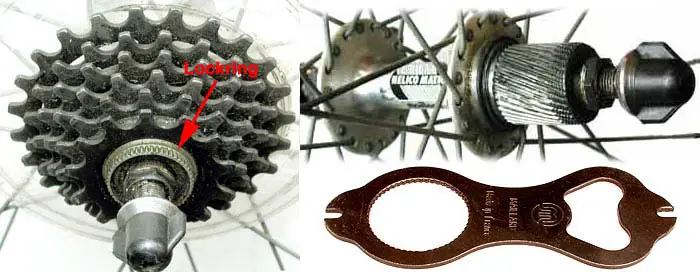
The Maillard Helicomatic hub was an early version of a cassette freehub. It came with a cute little pocket-size tool that incorporated a spline wrench for the cassette lockring, a spoke wrench, and a bottle opener. The Helicomatic was a nice idea on paper, but poorly executed. These hubs are losers.
Both hub flanges were 1mm farther to the left than those of a normal hub, causing increased dish in the rear wheel, and persistent spoke breakage problems. Many loyal Helicomatic fans tout the ease with which the cassette may be removed for spoke replacement as a great virtue, but if the hub were better designed, it wouldn't break so many spokes!
These hubs were prone to bearing problems as well. Due to clearance requirements, they couldn't fit the normal 9 1/4" bearing balls, so they used 13 5/32 balls on the right side. These didn't hold up well. The cones tended to wear rapidly, and replacement cones are no longer available to fit these hubs.
-
- A frame design in which the seat stays don't go to the seat cluster, but rather cross outside of the seat tube a few inches below the seat cluster, then go on to be attached to the top tube a few inches forward of the seat tube.
Hellenic stays were introduced by (and named for) the British frame builder Fred Helens in 1923, and have been used off-and-on since by frame builders who wish to make their frames visually distinctive. They are of no practical value, and often cause un-necessary complication in brake-cable routing, luggage-rack attachment and installation of frame pumps. The are also slightly heavier than normal frame construction.
Recent users of this design include GT, Huffy and Nash bar.
-
- [This entry by John Allen]
A protective hat. The so-called "leather hairnet" was commonly worn by bicycle racers until better designs with actual impact protection superseded it. A few cyclists, notably Dr. Eugene Gaston, medical columnist for Bicycling magazine, had taken to wearing hockey or mountaineering helmets around 1970. Club riders and racers saw the need for head protection, but there was not yet a helmet optimized for best protection compatible with a cyclist's need for light weight, unobstructed vision and ventilation. Around 1973, Mountain Safety Research introduced a modified mountaineering helmet which used cloth webbing attached by eight deformable side clips to provide impact absorption. MSR later added EPS (expanded polystyrene) foam inserts between the webbing straps. The next year, Bell introduced the Bell Biker, the first helmet designed from scratch specifically for bicycling. It used EPS as its impact-absorbing material, and had tapered ventilating inlets, as do most other bicycle helmets made since. Bicycle helmets are designed to mitigate the impacts resulting from a fall to the ground from riding height. These impacts are entirely able to cause permanent brain injury or fatalities, and account for most impacts in bicycle crashes.
Modern bicycle helmets have been of three main types:
- Hardshell:
The MSR and Bell helmets, and other early ones, were of this type. They had a hard plastic shell, to resist penetration by pointed rocks, curbs, etc. Most skate-style helmets are still made this way.
- No-shell:
for a short while, in the late 1980s, helmets were produced with the expanded polystyrene shell covered only by thin cloth. The first such helmet was developed by Jim Gentes, who founded Giro. This helmet passed the helmet-testing standards of the time and weighed less than other helmets, but questions arose as to whether the polystyrene might become snagged on rough pavement, causing brain and neck injury due to head rotation. Also, such helmets would often break apart on impact.
- Thin-shell:
The plastic shell is too thin to provide protection against object penetration, but it does provide a smooth surface to avoid snagging on rough pavement, and helps to hold the helmet together on impact. In high-end helmets with big vents, reinforcing of plastic, nylon or more exotic materials is molded inside the expanded polystyrene. Most helmets made and sold since 1990 are thin-shell helmets.
Bicycle helmets over the years
| Hairnet |
MSR, 1973 |
Bell Biker, 1974 |
No-shell, 1990 |
Thin-shell, 2004 |
| (no photo yet) |
 |
 |
 |
 |
A helmet should preferably be bright-colored, for the best visibility turning daylight hours, and reflectorized to improve nighttime visibility A helmet can be a good place to hang a rear-view mirror, headlight or miniaturized video camera, though at some small increased snagging risk to the cyclist.
-
-
[This entry by John Allen]
There has been heated controversy ("helmet wars") among cyclists and cycling advocates about helmet laws and helmet use. The helmet skeptics are primarily libertarians opposing helmet laws and riders who see helmet advocacy as unthinking protectionism. Although small in numbers, they are adamant, and fill blogs and bulletin boards with anti-helmet messages, giving rise to the term "helmet wars".
Studies of helmets and of injury rates show that helmets should, do, prevent or reduce injury. Aside from compulsory helmet laws, the primary helmet issue to an individual is the risk that he or she is willing to take (and to impose on family, friends and society at large) -- versus the cost and inconvenience of the helmet. For the creators of this Web site, the decision is, well, a no-brainer. Consider John Allen's helmet story...
An individual deciding to wear a helmet probably has already decided to ride a bicycle; an individual forced to wear a helmet by a law may not have made that decision, and some studies show a reduction in bicycle use if helmet laws are enforced. Also, some studies that look at a population at large show no reduction in fatality rates with helmet laws. This situation has been attributed to a low actual percentage of helmet use and by some to "risk homeostasis" -- that cyclists who wear helmets might compensate by taking more risks -- which, on the other hand, can mean riding more and taking trips that would otherwise be avoided!
Bicycling advocates who dismiss helmet use generally assume that the greater good is achieved by convincing more people to ride bicycles, even at the expense of avoidable injuries. Helmet advocates, on the other hand, have included not only many safety-conscious cyclists but also general-purpose safety advocates -- in particular in the USA in the 1990s, Safe Kids USA. Both sides have more in common than they might think: both like to make decisions for other people. Both often fail to consider unintended consequences. Helmet opponents consistently deny the robust scientific data supporting helmet use. Non-cyclist helmet advocates have had to learn that there is more to safe bicycling than helmets; that promotional campaigns and helmet giveaways to low-income people are more effective than laws; and that fairness requires a helmet law to include a liability exclusion, so a cyclist is not held responsible for a crash caused by another person, simply because of failure to wear a helmet.
It has correctly been asserted by advocates on both sides that avoiding a crash is preferable to crashing in a helmet. But beyond this, safer roads, careful and skillful cycling and use of other safety equipment, particularly lights at night, reduce injury risk to the entire body more than wearing a helmet on the head. Physical exercise from bicycling increases life expectancy more than risk decreases it, even without a helmet -- though this last argument fails to take quality of life into account. Exercise increases life expectancy by a few years for large number of people, while helmet use can increase it by decades for those who crash, and also prevent long-term disability. There is also no reason to think that bicycling is the only form of exercise that a person avoiding helmets would use.
Web sites for more information on helmets and the helmet wars issues:
-
- Dan Henry was a very influential cyclist in the 1950s and 1960s. He is most famous for the "Dan Henry Arrow" an arrow painted on the roadway with a stencil. brush or spray can, as a way of giving directions for organized rides. Many recreational bike clubs use Dan Henry arrows to mark their recommended routes.
He did a lot of pioneering work on suspension
designs for bicycles, and developed a bicycle seat that was based on an upside-down dropped handlebar
with furniture webbing wrapped between the two straight sections.
He was also known for roller
demonstrations where he would perform a strip-tease (down to his shorts, then put all his clothes back on again while riding on the rollers. A very cool guy.
-
- High flange (hub)
-
- A high gear is one in which the pedals move slowly compared to the speed of the wheels. High gears are achieved by using large chainwheels and small rear sprockets.
High gears are for going fast, when the terrain permits. The rider must push much harder on the pedals in a high gear, so high gears are not suitable for lower-speed riding, due to the great strain that hard, slow pedaling puts on the joints.
-
- See "flange."
-
- See "Low-normal."
-
- Wheelie bike.
-
- A fancy-sounding name for the ordinary tubing used to build cheap bicycle frames.
-
- The second-oldest style of bicycle, the successor to the "bone shaker," and the predecessor of the modern "safety" bicycle."
Before the use of chain drive, bicycles had direct drive. The cranks were directly attached to the hub of the drive wheel. The larger the wheel, the farther the bicycle would move with each turn of the pedals. The diameter of the drive wheel determined the gear of the bicycle. The larger the wheel, the higher the gear.
With a chain-driven "safety" bicycle, you can have any gear you want by selecting appropriate sprockets. With a high-wheel bicycle, the limiting factor is how long your legs are, because you can only pedal a wheel that is small enough for your legs to straddle and reach the pedals throughout the pedal revolution.
The safety bike was first introduced on a commercial scale in 1885, and by 1893 high-wheelers were out of production -- with one exception: children's tricycles, even today, are direct descendents of the high wheeler. The only differences are that they are smaller, and that instead of a single rear wheel, they have a platform with a rear wheel at either side.
-
- A spring device which attaches to the seatpost and to a quick-release seatpost bolt. It allows the rider to adjust the saddle height while riding. This was a fashionable option in the early days of mountain biking, but is no longer popular.

Since May 4, 1996
If you would like to make a link or bookmark to this page, the URL is:
http://sheldonbrown.com/gloss_ha-i.html
If you would like to make a link or bookmark to this glossary, the URL is:
http://sheldonbrown.com/glossary
If you would like to make a link or bookmark to a specific definition, that's fine too. I am committed to keeping the urls stable, so I won't be breaking your link.
|
|