
Sheldon Brown's
Bicycle Glossary U - V

|

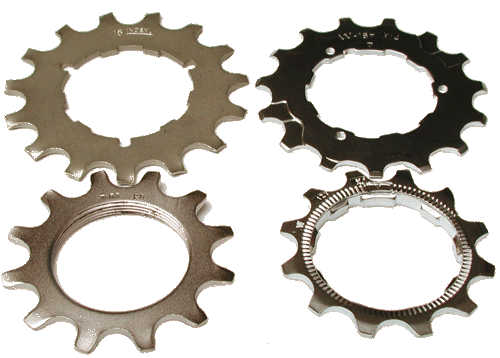
Ultra spacing, 5 mm center to center,is identical with the spacing of Shimano 7-speed cassettes; Shimano 7-speed or 8-speed shifters can be used to index these freewheels. This shifting isn't as clean as with Hyperglide cassettes, but it is much nicer than friction shifting.
Ultra spacing was made possible by the development of chains in which the ends of the rivets did not protrude far past the side plates. 7- and 8-speed freewheels are also Ultra spaced, but the term is mainly used to describe the narrow 6-speed units.

See also my article on Shimano Cassettes.
 |
|
|---|---|
| Uniglide ® | Hyperglide ® |
Upright handlebars are sometimes referred to as "mountain bike " handlebars, but that's sloppy usage, because upright handlebars are also used on most bikes designed for street use.
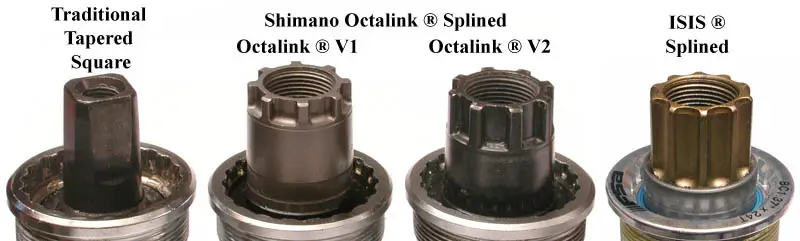
The V2 BBs work with FC M752, FC M751, FC M572, FC M571, FC M510-8 and FC M440-8 cranks.
 |
 |
 |
|---|---|---|
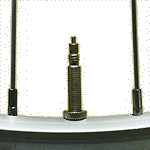
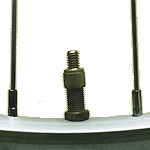
| Schrader valve | Presta valve | Woods valve |
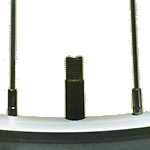
Presta valves have non-removable, built-in caps, and external caps are unnecessary.These redundant caps come with Presta tubes and tubulars so that the pointy end of the valve won't puncture a spare tube or tubular while it is rolled up. There's no reason to use them in actual riding
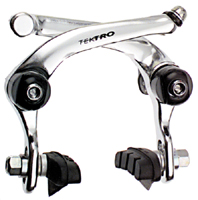
V-Brakes and other direct-pull cantilevers have more mechanical advantage than other brakes, so they require special hand levers with less-than-average mechanical advantage to keep the overall mechanical advantage in a useful range.
Some V-Brakes also incorporate a parallelogram linkage which maintains the shoe at the correct angle as it approaches the rim. This feature also allows the motion of the shoe to be more nearly horizontal than with conventional cantilevers.
"V-Brake" is a Shimano trademark.
In the post WW2 era, most Japanese industries acquired similar governing bodies under the J.I.S.C. (Japanese Industrial Standards Committee). These agencies helped to turn around the international reputation of Japanese products from the former stereotype of cheap copies of western designs to their present high reputation for quality and reliability.
Also, British spelling of "vise ."
This is a tool of last resort for removing nuts or bolts whose heads are so badly damaged that the proper wrench will not fit them. Vise-grips should not be used on un-damaged fasteners, because their serrated jaws will damage the part they are used on.
Last Updated: by Harriet Fell