French Bicycles

|

revised by John "et moi aussi" Allen

Le beau est aussi utile que l'utile -- Victor Hugo
(The beautiful is as useful as the useful)
French bicycles are often of very high quality, but they have their own idiosyncracies and interchangeability problems. This article tries to point out the pitfalls that you may run into in maintaining or upgrading a French bicycle, and offers solutions to common problems.
In the great bike boom of the early-mid '70's, French bicycles were sold in the U.S. in very large numbers, mostly low-end ten speeds with mild steel frames, steel rims and cottered cranks. These low-end models are generally not worth putting any money into, unless you have a strong sentimental attachment to one. Such a bike can be suitable for use as a "beater" to ride short distances, perhaps to the train station where you can lock it up without worrying about theft.
[A note from John Allen: I think that Sheldon overgeneralizes here. Some of the low-end models make for a very nice ride if customized with better components. I'm not the only cyclist who praises the excellent handling qualities of the UO-8, Peugeot's bottom-of-the-line 1970s 10-speed. There are probably other low-grade French bicycles as good. The UO-8 frame has unusually long chainstays, for ample heel clearance when carrying rear panniers. The plain-gauge steel frame tubing is a bit heavier than fancier butted tubing, but the added stiffness is welcome when carrying a touring load, and plain-gauge tubing doesn't dent easily like thin-walled butted tubing. A UO-8 is my favorite touring bike. So there!]
Higher quality French bicycles, with cotterless cranks and aluminum rims are usually worth restoring or upgrading. These bicycles are also often a good choice for conversion for fixed-gear use. Unfortunately, some of the dimensions and thread standards used on older French bicycles can make it difficult to find suitable parts for repair or upgrading.
[Also in connection with this article, see Sheldon's article on upgrading...John Allen]

| British/I.S.O. | French | |
| Top tube | 1" (25.4 mm) | 26 mm |
| Down tube | 1 1/8" (28.6 mm) | 28 mm |
| Seat tube | 1 1/8" (28.6 mm) | 28 mm |
| Handlebar stem | 7/8" 22.2mm | 22mm |
| Handlebar clamp | 25.4 mm, 26 mm | 23.5 mm, 25 mm |
| Steerer threads | 1" x 24 tpi (25.4 x 1.058 mm) | 25 mm x 1.0 mm |
| Headset-crown race | 26.4 mm (J.I.S. 27 mm) | 26.5 mm (sometimes 27 mm) |
| Headset-head tube | 30.2mm (J.I.S. 30 mm) | 30.2 |
| Bottom Bracket width | 68 mm | 68 mm |
| Bottom Bracket thread | 1.3701/1.375 x 24 TPI | 35 mm x 1mm (1.378 x 25.4 tpi) |
| Fixed cup | Left thread | Right thread (Swiss: Left thread) |
| Pedal threads | 9/16 x 20 TPI | 14 mm x 1.25 mm |
| Freewheel threads | 1.370/1.375 x 24 TPI | 34.7 mm x 1mm (1.366" x 25.4TPI) |
| Cotters | 3/8" (9.5 mm) | 9 mm |
 Handlebars/stems
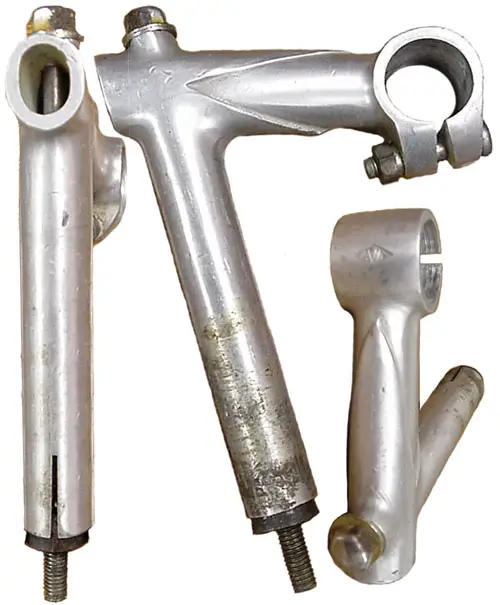
French stems differ both in the size that fits into the steerer, and the size of the part that clamps on to the handlebar. Thus, if you want to replace the handlebars on a French bicycle, you will probably also need to replace the stem.
French stems are 0.2mm narrower than others where they fit into the steering column. A standard 7/8" / 22.2mm stem won't usually fit. In many cases, the limiting factor for fitting the stem in will be the headset locknut, rather than the steerer itself. Try removing the locknut before sanding down a stem. If the headset locknut is slightly tighter than the steerer, it can be enlarged easily with a small grinding wheel.
In cases where the stem really won't fit into the steerer, a few minutes' work on the stem with sandpaper will usually do the trick. Wrap the sandpaper around the stem, grip it with your hand, and turn the stem round and round until it fits. You only need to remove 0.1 mm, which is 1/250", not much at all! [This needs to be a quill-type stem, which inserts into the steerer tube, and an aluminum alloy stem, not a steel one -- from which you would be removing chrome plating, leaving it vulnerable to rust. Another approach is to replace the fork and the headset with ones with standard British/ISO dimensions. This is possible, as French head tube bearing race dimensions are 30.2mm, the same as British. You could use a standard 22.2 mm quill stem, or a threadless headset and a 1-inch Aheadset-type stem. Also, an adapter is available as of 2014 to fit a 1 1/8" Aheadset-type stem to a French fork.-- John Allen]
If you convert from a French stem to a standard one, you will also need to replace the handlebars, which are a different diameter.
French headsets use a different type of keyed washer than others. Instead of having a groove machined in the threads, the rear part of the threads is filed flat. French headsets commonly used a serrated keyed washer, with matching serrations on the threaded bearing race. This makes French headsets slightly harder to adjust, but once they are adjusted, they hold their adjustment better than conventional designs.
French bottom bracket cups usually have thinner walls than Japanese ones, so the bearing ridges on the spindles are farther apart. If you use a standard Japanese spindle, the adjustable cup won't be able to screw in far enough to snug up the bearings, or if it does, it will sink into the bottom bracket shell so that you won't be able to install the lockring.
The good news is that a Japanese spindle made for an Italian size (70 mm) bottom bracket will usually fit! In the J.I.S. marking system, these are the spindles that are marked with a "5" code. Spindles for 68 mm bbs have codes beginning with 3. This trick often makes it possible to upgrade an older bike from cottered to cotterless cranks, at a reasonable cost, or replace a worn French cotterless spindle that is no longer available -- but see warning below about French crank extractors.
Few cartridge bottom brackets are available in French thread, but Phil Wood retaining rings are available in French size. They work with Phil Wood bottom brackets and Shimano UN72 units. Velo Orange makes a cartridge bottom bracket which uses expanding sleeves instead of threads, and also will work in a French-threaded frame.
French-thread bottom brackets, like Italian, use regular right threading on both sides. This means that the fixed cup will have a tendency to loosen up in use. The best prevention is to make sure it is really tight. In some cases, a thread adhesive may even be called for.
Some French bicycles, notably many Motobécane models, used Swiss thread bottom brackets. These have the same thread and diameter as French, but use a left thread for the fixed cup. This makes life interesting when you need to remove the fixed cup and don't know which way to turn it. Good luck. Phil Wood and velo Orange offer the same options as with French bottom brackets.
Newer French bicycles commonly use Italian or British/I.S.O. bottom brackets.
See the selection of French bottom brackets and parts at Harris Cyclery.
Older TA and Stronglight cranks each had their own unique thread for for the crank extractor, and you will need to get the correct puller for the crank you are working on. TA used a 23 mm extractor, Stronglight used 23.35 mm until 1982, when it converted to the standard 22mm diameter. You must use the correct crank extractor. Be especially careful not to use a TA extractor on a Stronglight crank. It will thread in, but it may strip the threads in the crank.
Some J.I.S. Japanese spindles have studs on the ends threaded for nuts to hold the cranks in place, instead of bolts that thread into ends of the spindle. Many TA or Stronglight crank extractors do not work with a stud-end spindle, because the plunger can not be retracted far enough. You could use a gear puller (sold at auto parts stores) to remove a crank if you don't have an extractor that will work. Next time, use a bolt-type spindle!
Older Stronglight cranks used bolts with a 16 mm head. The common Park crank bolt wrench [unfortunately no longer made] will turn these, but most other socket wrenches will not fit inside the extractor hole. Use only bolts with a 14 or 15 mm head in a crank with a smaller extractor thread diameter.
The vast majority of French bicycles imported into the U.S. used standard 9/16" x 20 tpi crank threading, but if you find an older bicycle that was bought in France, you may run into this problem. The French-thread cranks can be tapped out to 9/16". This is much easier (and more worth the trouble) with aluminum cranks. Start the taps from the inside of the cranks, so any possible thread damage occurs where it doesn't matter. French pedals will often be marked "G" (Gauche=left) and "D" (Droite=right).
French-thread freewheels used a smaller diameter attachment to the hub. Neither the freewheels nor the hubs are interchangeable with anything else. Fortunately, they are quite rare: virtually all French bicycles sold in the U.S. had standard British/I.S.O. freewheel threads. In any case, unless you are restoring a collector's item, you will do well to spread the rear dropouts, and upgrade to a modern rear wheel with a cassette hub and index shifting -- see my article on frame spacing.
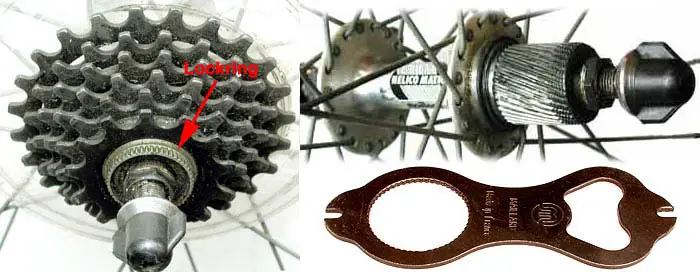
Both hub flanges were 1mm farther to the left than those of a normal hub, causing increased dish in the rear wheel, and persistent spoke breakage problems. Many loyal Helicomatic fans tout the ease with which the cassette may be removed for spoke replacement as a great virtue, but if the hub were better designed, it wouldn't break so many spokes!
These hubs were prone to bearing problems as well. Due to clearance requirements, they couldn't fit the normal 9 1/4" bearing balls, so they used 13 5/32" balls on the right side. These didn't hold up well. The cones tended to wear rapidly, and replacement cones are no longer available to fit these hubs.
The better models, those with Reynolds 531 or other high quality tubing, commonly featured Simplex forged fork ends, with built in Simplex-type derailer hangers. These are not the same as the Campagnolo- and Shimano-type hangers used on modern bicycles. It is possible, however, to modify Simplex hangers. They have an unthreaded mounting hole, which may easily be tapped out to the standard 10 mm x 1 mm thread used by modern derailers. Standard derailer hangers also have a step at the bottom edge which limits the forward swing of the derailer. This can usually be supplied by judicious use of a file. Its angle may differ depending on the derailer. If the derailer hanger can't be made to work, you might remove it and braze on one that does, or use an adapter claw.
Fortunately, though, the thickness of most spokes is by now labeled in millimeters. When in doubt, measure! Spoke threading also may differ, so always get new spoke nipples to go with new spokes.
Bicycles built for the French market and informally imported generally use one of 3 tire sizes:
The 584 mm (650 B) size is recently making a bit of a comeback! See my article on 584 mm/650 B wheels.
There is a French organization dedicated to preserving this size: La Confrérie des 650B
French Bicycles
The following is a list of some French bicycle brands that I have come across,
with scattered information about them.
I welcome additions and corrections.
| Astra | Beacon Cycle house brand, made by Motobécane |
| Automoto | Older, high end brand, rarely seen in the U.S. Like most other major French marques, headquartered in St. Étienne, east of Paris. l902-1965 |
| Bertin | Better-than-average '70's bikes. |
| Louison Bobet | Good bikes in their day,('60's-'70's). Distributed by Cyclopedia. Named after a great French racer. |
| Dilecta | Very fine old touring tandems, with a logo very similar to the Vietnamese flag. |
| Follis | Decent brand, especially known for tandems. |
| Flandria | Actually Belgian, not French. Most Flandrias seen in the U.S. were low-end bike-boom clunkers, some of them made in Portugal. |
| Ginay | Low end bike-boom line. Jeunet sound-alike |
| Ginet | Low end bike-boom line. Jeunet sound-alike |
| Gitane | Major brand. Jacques Anquetil and Greg Lemond used to race on Gitanes. |
| Gnôme Rhône | Primarily an aircraft engine maker, which also built bicycles in the '50's. I had one when I lived in France. It had aluminum main tubes held into steel lugs by rivets. |
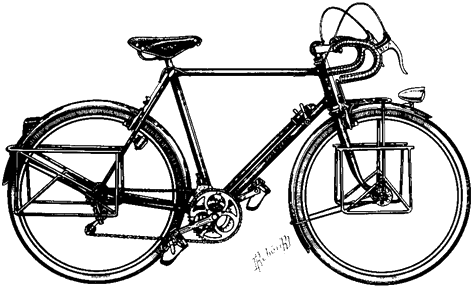
| René Herse | The pinnacle of French cycling, specializing in top-of-the-line custom and semi-custom touring bikes; extremely valuable. The image above is a Daniel Rebour illustration of a René Herse "Camping" model. The brand has been revived by a bicycle maker in Boulder, Colorado, USA. |
| Jeunet | Good quality bike-boom models. |
| La Perle | Jacques Anqueteil and I both used to own La Perles. I gave mine to my sister. I don't know what he did with his. Mine was 531, with sidepull brakes, tubulars, Titan bar and stem... |
| LeJeune | Good quality singles and tandems. |
| Look | Current maker of very high-tech carbon fiber frames, and clipless pedals. |
| Lapierre | Based in Dijon, full line manufacturer, made some high-end racing bikes, but most Lapierres seen in the U.S. are generic low-end bike-boom machines. |
| Mel Pinto | Virginia-based importer/wholesaler, formerly imported Gitane bikes to the U.S., also sold a rather nice tandem under the Mel Pinto name, reportedly made by Urago. |
| Mercier | Major Peugeot competitor in the '70's. The model 100 was very similar to the Peugeot UO-8; the 300 was comparable to the PX-10 The Mercier trademark has been revived, but the current production "Merciers" from the Far East have no connection with France aside from the name. |
| Motobécane/MBK | One of the largest manufacturers of bicycles and motorcycles. "Moto" is French for motorcycle; "bécane" is French for "bike". After bankruptcy, the company was reconstituted as MBK (pronounced "em-bay-kah.") The Motobécane trademark has been revived, but the current production "Motos" from the Far East have no connection with France aside from the name. |
| OTB | "Only The Best"; private label of Charlie Hamburger, Boston bike maven and dealer of the '40's and '50's. Hamburger was reputedly a fanatic for quality, who would disassemble freewheels to add more bearing balls. He was reputed to have been the first to import Campagnolo parts to the U.S. Some OTBs were reputedly made by René Herse, others high-end Peugeots. I own a 1957 OTB, supposedly the last that he sold when he closed the shop. It is made of Vitus tubing, and has the skinniest seat stays I have ever seen. |
| Peugeot | The Goliath of the French bicycle industry. Maker of automobiles, bicycles and pepper grinders. |
| In the '70's bike boom, the $87.50 UO-8 was the hot model for the hoi polloi: carbon steel frame, steel rims & handlebars, Mafac brakes, Normandy large flange quick-release hubs, Simplex Prestige derailers. The UO-8 (and the mixte version UO-18) had the lowest gearing of stock bikes at that time, thanks to the 52/36 chainwheel set. | |
| Contemporary with the UO-8/UO-18 were the UE-8 and the mixte UE-18. These were set up as touring bikes, with full fenders, brazed-on rear rack, generator lighting system with brazed-on mount. Unaccountably, this model, which was made of the same materials as the UO-8 and shared most components, had close-ratio gearing, making it much less useful than it could have been. | |
| The deluxe bike-boom Peugeot was the PX-10, all Reynolds 531, Nervex lugs, Mavic tubular rims, Normandy Luxe Competition hubs, Brooks Professional saddle, Stronglight 93 cotterless cranks. [This model was fine for racing but notorious for speed wobble if carrying a load on a rear rack -- John Allen] | |
| The top-of-the-line model was the PY-10. Here's a reminiscence from Lyle Rooff:
I sold a couple of those when I owned a bike store in the late 1970's and early 80's. It was quite different from any other model, having not only an all-531DB frame and fork, but included gold-anodized Mafac brakes and a few other components not found on production bikes. Getting them into the shop was a different experience, as well. It came fully assembled in a box resembling a piano crate, requiring only that we turn the handlebars straight and inflate the tires for it to be ready to ride. They were, in all respects, identical to the bikes used by the factory team.
|
|
| See also: | |
| St. Étienne | A mid-range marque. The city of St. Étienne was for many years the capitol of the French bicycle industry. |
| St. Tropez | An undistinguished low-end marque. Some of these are Taiwanese, not French. The bottom of the barrel. |
| Alex Singer | Close runner-up to René Herse for top honors as high-end microbrewer. There is some dispute as to whether the name should be pronounced in the French or English fashion. |
| Stella | |
| Terrot | Older, high end brand, rarely seen in the U.S. |
| Urago | A high quality brand from the south of France. |
| Velosolex | Made both bicycles and weird front-wheel drive mopeds, as well as being a major manufacturer of carburetors. As of 2010, the name has been revived for electrically-powered mopeds which mimic the appearance of the old ones. |
| Vitus | Vitus was a long-standing maker of high-quality frame tubing. In the '80's they popularized glued aluminum frames, which were very light and quite popular with lighter riders. |
| AGDA | Low end leather saddles, standard equipment on the Peugeot UO-8. |
| Atom | Hubs, including rear drum brake popular on older tandems. |
| Atom also made some decent pedals. Absorbed by Sachs? | |
| Ava | Handlebars and stems. Don't ride on them, they break! Also rims. |
| Christophe | Toe clips and straps. |
| CLB | Brakes. The CLB brakes sold on U.S. market bikes were not as good as Mafacs. |
| CLB also made a self-energizing centerpull brake with helical pivots, similar to Scott Pedersen cantilevers. | |
| For the cyclist who prefers lightness to safety, CLB also made aluminum brake cables! | |
| Cyclo | French Cyclo was a different company from British Cyclo (Benelux). |
| Early touring derailer mounted to chainstay, used dual cable and external tension spring (There is one on the René Hérse pictured above.) | |
| Cyclo Pans freewheel kit was a quick-change freewheel, the first to use splined sprockets like a modern freewheel of cassette. The fact that you could change ratios without having to remove the freewheel from the hub was a big deal in the '60's | |
| Excell | Good-quality frame tubing. |
| Huret | Allvit derailer, the first inexpensive parallelogram-type derailer(early '60's). |
| Duopar super-wide-range derailer, used two parallelograms to extend chain take-up. Very hot stuff in the late '70's. | |
| Jubilee, the lightest derailer ever marketed. | |
| Multito cyclometer was the first quiet cyclometer, using a rubber belt drive instead of the older star-wheel design. | |
| Bought by Sachs, name changed to Sachs. Then Sachs was bought by SRAM, name changed to SRAM. | |
| Hutchinson | Tires. Still in business. Its 1970's products were of poor quality, but reportedly they have improved considerably since then. |
| Idéale | Fine leather saddles, similar to Brooks. Super-light models used flat aluminum rails. |
| Lapize | Toe straps--affiliated with Christophe. |
| Look | Ski binding company, invented the first practical clipless pedal, revolutionized the market. |
| High tech carbon fibre frames and disc wheels rarely seen in U.S. | |
| Special rear hub with strain-gauge power measuring unit. | |
| Lyotard | Pedals. The Model 23 "Marcel Berthet" platform pedal was one of the most elegantly designed bicycle parts ever. This pedal is the easiest-entry toe-clip type pedal ever made, and is remarkably light, especially considering its all-steel construction. |
| Maillard | Hubs and freewheels. Absorbed into Sachs. |
| Helicomatic hub was an early cassette freehub. | |
| Mafac | The best French bicycles of the 60's and early '70's all had Mafac brakes. Mafac made both centerpull calipers and cantilever brakes. Some high-end French custom builders disassembled Mafac centerpulls, and brazed the pivots to the frame, turning them into what we now call a "U-brake" "MAFAC" is an acronym from: "Manufacture Auvergnoise de Freins et Accessoires pour Cycle (Manufacturer in the Auvergne of Brakes and Accessories for Cycles.) |
| Mavic | The number 1 French rim maker. In the '90's they diversified into other components. Their hubs and cranksets are highly regarded.
"MAVIC" is an acronym from "Manufacture d'Articles Vélocipediques Idoux et Chanel. (Idoux and Chanel were the names of the partners who founded the company in 1890.) |
| First company to market an electronically controlled derailer. New ownership has led to retrenchment; now Mavic makes rims and wheels, as well as some clothing and bicycle computers.. | |
| Maxicar | Very good hubs. Maxicar drum brakes were fitted on the finest French tandems, they had large enough flanges that spokes could be replaced without removing the freewheel. |
| Michelin | Tires. The Michelin Élan was the first modern high-performance clincher. |
| Nervar | Cranksets. These had a different bolt circle from any other. |
| Nervex | Lugs. Ornate Nervex lugs were very popular on high end frames until the mid-'70's, when simpler styles came into fashion. |
| Normandy | Normandy hubs were supplied on almost all '70's bike boom imports. Normandy also made freewheels, and, I believe, was the first to make a freewheel that used a splined remover. |
| Phillipe | Handlebars and stems, good quality. |
| Prugnat | Lugs. Best known for simple, Italian-style lugs. |
| Rigida | Rims. Steel Rigida rims with textured braking surfaces were standard equipment on mid-line bike boom bikes. |
| Robergel | Spokes. the "3 Étoiles" (3 stars) model was widely considered the finest spoke available, until DT came along. |
| Sachs | A German conglomerate, has absorbed much of the French industry, including Atom/Maillard, Huret, and Sedis. |
| Sedis | The world's best chain, bought by Sachs which was bought by SRAM. |
| Simplex | The Simplex Prestige derailer was very hot stuff in 1960. It was largely made of plastic. This model was being supplied unchanged until the mid-'70's when Sun Tour blew it away with a more modern design. This was the beginning of the end of French bicycle exports to the U.S. Simplex also made quick-release skewers and high-end microadjustable seatposts. Simplex "Rétrofriction" shift levers have a cult following, and are regarded as the finest non-indexing shift levers ever. |
| Stronglight | Innovative maker best known for cranks and headsets. Stronglight pioneered the use of roller bearings in these parts. The headsets are still quite popular. |
| Super Champion | Excellent rims. The Model 58 clincher was for years the top choice for loaded touring. It was the first common aluminum-alloy clincher rim with parallel sidewalls, allowing brakes to work smoothly even on out-of-round wheels. The "Arc en Ciel" ("Rainbow") tubular rim was the state-of-the-art for lightweight racing rims. Super Champion is now a division of Wolber. |
| TA | France's top maker of cranks. The "Cyclotouriste" was for many years the triple chainwheel set-up. TA also used to own the market for bottle cages and shoe cleats. They also make (or at least used to make) special orthopedic pedals with interchangeable cages to accommodate riders with one leg longer than the other. |
| Time | Clipless pedal/shoe systems, the first to feature "float" |
| Velox | Patch kits, the world's best rim tape. ("Fond de jante" is French for "bottom of rim".) |
| Vitus | France's leading manufacturer of high-quality frame tubing. Also a major builder of frames from aluminum and carbon fiber. |
| Wolber | Primarily a tire manufacturer; purchased Super Champion's rim business. |
| Zéfal | The world's leading pump manufacturer. The Zéfal HP was the first frame pump that would give satisfactory performance with unmodified Schrader valves. |
| Huret | Huret used to make a very nice little 1/4" drive socket set, with an "L" shaped handle and 5 handy sockets. Alas, this is no longer available. |
|---|---|
| Facom | The Snap-On of France. Very high quality tools, not cheap. If you visit France, you should look into the Facom "Pince-Étau" locking pliers, which are the nicest I have seen, even better than genuine Vise-Grips. The Facom unit combines a slip-joint with the link-lock function, providing a very wide range of adjustment, and quick operation. |
| The "clé à pipe" is a very handy style of wrench unknown in the U.S. It is an "L" shaped wrench with a socket on each end. The socket on the short end is open, so it can fit over long bolts. | |
| Mafac | Used to make a very compact tool kit that mounted behind the saddle. In its day, this was quite a nice set, though modern multi-tools have surpassed it. |
| VAR | The main source of professional bicycle tools in France. VAR tools are quite solid and well made, but roughly finished and old-fashioned in design. VAR tools are available from U.S. bicycle sources, but tend to be expensive due to the current exchange rate of the euro to the dollar.
Online scans of the classic VAR Tool Catalogue |
Other French-Related pages on this site: |
|---|
Harris Cyclery's page of Parts for older French Bicycles |
Thanks to Jeff Travis for his kind assistance.
Last Updated: by John Allen